<nav aria-label=”Breadcrumb”>
Home » Industry Deep-Dives » <strong>Food & Beverage</strong>
</nav>
Food & Beverage Industry Ladders — Hygienic Steel Access Solutions
Food and beverage processing facilities operate under stringent hygiene regulations enforced by the FDA (US), European Commission (EU 852/2004), and global food safety standards (BRC, FSSC 22000). Every surface in a production environment — including access ladders — must be cleanable, non-absorbent, non-toxic, non-shedding, and resistant to the specific cleaning chemicals and washdown procedures in use. A ladder that traps food particles in crevices or sheds rust flakes onto a production line is a contamination risk that can trigger a HACCP non-conformance.
Dengtai supplies SS304 and SS316 fixed ladders and platforms purpose-built for food industry environments. Design features include continuous ground-smooth welds (no crevices), all-SS316 fasteners, sloped drainage surfaces, and 240# brushed + passivated finish that does not shed particles.
Industry Pain Points
Crevices trap food debris and bacteria. Stitch-welded ladders (intermittent welds, standard in general industrial fabrication) leave gaps between the weld runs where food particles, moisture, and bacteria accumulate. These crevices are impossible to clean effectively with standard washdown procedures. Dengtai food-grade ladders use continuous welds ground smooth and blended to the surrounding surface — eliminating every crevice on the product.
Chlorine-based sanitizers attack standard stainless steel. Sodium hypochlorite (bleach) is the most common sanitizer in food processing. While SS304 resists many food acids, prolonged or concentrated chlorine exposure causes pitting. Dairy, meat, poultry, and seafood facilities that use chlorine sanitizers should specify SS316. The molybdenum content in SS316 provides the necessary resistance to chloride-induced pitting.
Carbon steel fasteners rust and stain. A common cost-cutting measure is using SS304 ladders with carbon steel bolts, nuts, and washers. Within months in a washdown environment, the fasteners rust, leaving orange stains on the stainless ladder surface and — in the worst case — rust particles that can contaminate product. Dengtai food-grade ladders use all-SS316 fasteners throughout.
Flat surfaces pool water. Horizontal surfaces on standard industrial platforms hold washdown water, creating a persistent wet zone where microorganisms thrive. Food-grade platforms must be sloped to positive drainage (minimum 1:50 fall) with grating oriented to allow water and cleaning solution runoff.
Recommended Ladder Solutions
FL-SS304-STD Stainless Fixed Ladder — Standard Food Processing
Best for: Beverage bottling, bakery, dry goods, and general food processing where cleaning agents are mild (non-chlorine) and food acids are moderate.
Specifications: SS304 (EN 1.4301), 240# brushed + passivated finish, continuous ground-smooth welds, all-SS316 fasteners, 600mm width, 350 lbs load rating.
Price: $61.50/m.
View FL-SS304-STD →
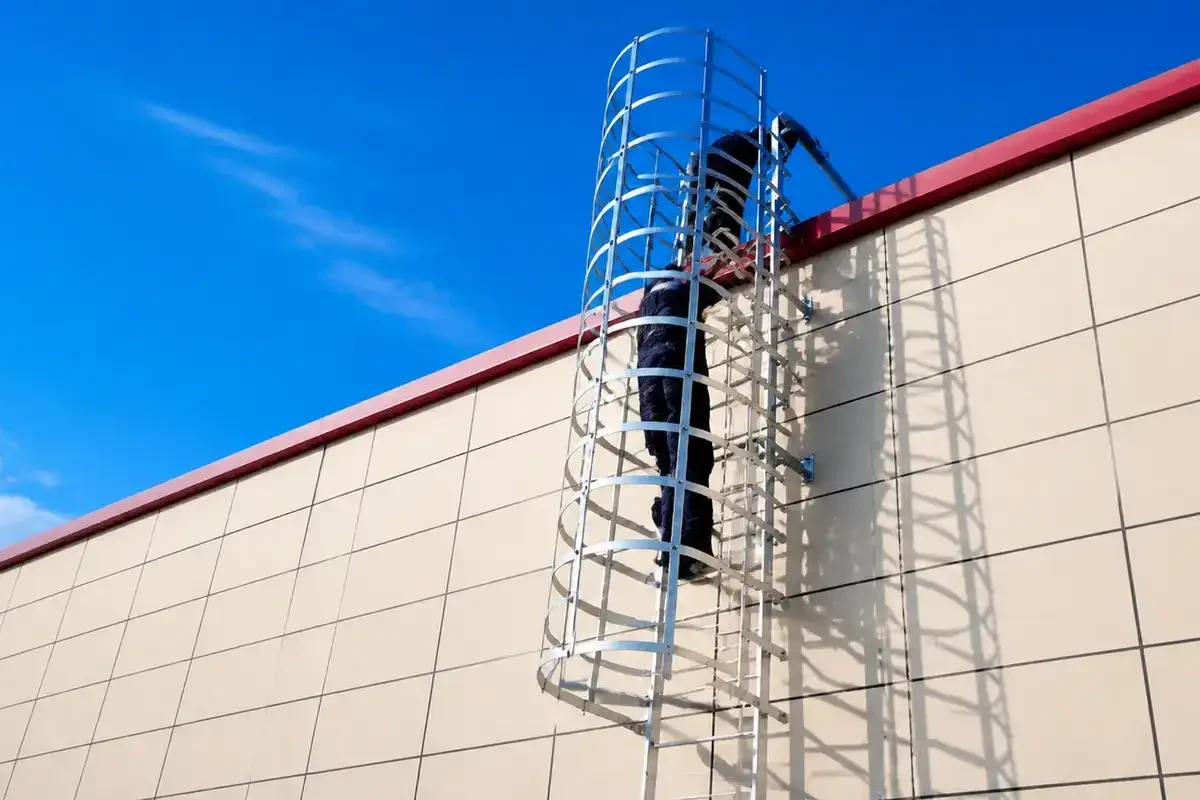
CL-SS316-STD Stainless Caged Ladder — Aggressive Washdown Environments
Best for: Dairy, meat, poultry, seafood, and brewery facilities using chlorine-based sanitizers or CIP chemicals. Tall access where a safety cage is required.
Specifications: SS316 (EN 1.4401), acid pickled + passivated finish, continuous ground-smooth welds, all-SS316 fasteners, cage diameter 800mm.
Price: $115.00/m.
View CL-SS316-STD →
FL-SS316-STD Stainless Fixed Ladder — Chlorine Sanitizer Environments
Best for: Fixed ladder applications in chlorine-sanitized facilities where height is below the cage threshold.
Specifications: SS316, same hygienic design features as SS304 variant.
Price: $73.00/m.
View FL-SS316-STD →
Material Selection by Food Sector
| Food Sector | Environment | Recommended Material | Key Risks |
|---|---|---|---|
| Dairy processing | Wet, lactic acid, chlorine CIP | SS316 | Chlorine pitting of SS304; lactic acid corrosion |
| Meat and poultry | Wet washdown, blood, chlorine sanitizer | SS316 | Blood is corrosive; aggressive chlorine cleaning |
| Beverage bottling | Wet, sugar residues, caustic cleaning | SS304 | SS304 adequate; no chlorine typically used |
| Bakery and dry goods | Dry, flour dust | SS304 or HDG | HDG acceptable in dry, non-washdown areas |
| Brewery and distillery | Wet, acidic (wort/beer), caustic CIP | SS316 | Combined acid + caustic + constant wetness |
| Fruit and vegetable processing | Wet, citric acid, chlorine wash water | SS316 | Chlorine in produce wash water |
| Seafood processing | Wet, salt, organic acids, constant washdown | SS316 | Salt + acids + continuous wet conditions |
| Edible oil processing | Oily, solvent extraction areas | SS316 | Solvent resistance (hexane); fire safety |
Hygienic Design Features
Continuous Welds, Ground Smooth
All structural welds are continuous (not stitch-welded) to eliminate crevices where food particles and bacteria accumulate. Welds are ground smooth and blended to match the surrounding surface finish — no visible weld bead, no undercut, no pinholes.
All-SS316 Fasteners
Every bolt, nut, washer, and anchor is SS316. No carbon steel fasteners anywhere on the ladder assembly. This prevents rust staining and eliminates a common HACCP non-conformance item.
Radiused Internal Corners
Where two surfaces meet at an internal angle (bracket to side rail, rung to stile), the corner is radiused (minimum 6mm) rather than sharp. Eliminates the 90-degree crevice where debris and cleaning residues accumulate.
Sloped Drainage on Platforms
Horizontal platform surfaces sloped minimum 1:50 to positive drainage. Grating oriented for water and cleaning solution runoff. No flat surfaces that pool water.
Regulatory Framework
| Regulation | Jurisdiction | Key Requirement for Ladders |
|---|---|---|
| FDA 21 CFR 110.40 | United States | Equipment designed to be adequately cleanable and properly maintained |
| EU Regulation (EC) 852/2004 | European Union | Premises must permit good food hygiene practices |
| BRC Global Standard | Global (retailer-driven) | Equipment design must facilitate cleaning and prevent contamination |
| FSSC 22000 / ISO 22000 | Global | Equipment design as a prerequisite program in food safety management |
| 3-A Sanitary Standards | US dairy | Specific design standards for dairy equipment surfaces |
| EHEDG Guidelines | Europe | Engineering design guidelines for hygienic equipment |
Dengtai provides a Declaration of Hygienic Design Conformity referencing applicable standards and design features. The end user retains responsibility for validating the ladder’s suitability within their specific HACCP plan.
Frequently Asked Questions
Can I use galvanized steel ladders in a food facility?
Only in dry, non-washdown areas such as packaging storage mezzanines or utility corridors physically separated from production. Galvanized steel must never be installed in any area subject to wet cleaning, food contact, or where zinc oxide corrosion products could contaminate product. When in doubt, specify stainless steel.
SS304 or SS316 — which should I choose?
SS304 is adequate for facilities using mild cleaning agents and processing non-acidic foods (beverage bottling, bakery, dry goods). Specify SS316 if your facility uses chlorine-based sanitizers (sodium hypochlorite/bleach), processes acidic foods (citrus, dairy, fermentation), or has an aggressive cleaning regime. If your sanitation program includes bleach at any concentration, choose SS316.
How do I document the ladder in our HACCP plan?
Include the ladder as an equipment item in your hazard analysis. Document: material (SS304/SS316 with finish specification), cleaning procedure (frequency, agent, method), inspection procedure (visual check for surface damage, corrosion, debris), and corrective action for non-conformance. We provide a material and finish specification sheet for your HACCP documentation.
Can ladders be supplied with an electropolished finish?
Yes. Electropolishing produces a surface roughness of Ra < 0.5 micron (versus Ra 0.8-1.2 micron for 240# brushed). This ultra-smooth finish is optimal for the most demanding hygienic applications. Electropolishing adds approximately 20-30% to the SS316 material cost. Specify at inquiry.
How do I get a quote for food-grade ladders?
Specify: ladder type (fixed/caged), height, quantity, material (SS304/SS316), food sector, cleaning regime (agents and frequency), and any specific standard requirements (3-A, EHEDG). Email sales@dtsteelladder.com or WhatsApp +86 155 1187 9488.
Food & Beverage Ladder Solutions
SS304 and SS316 hygienic finish. Continuous ground-smooth welds. All-SS316 fasteners. FDA, EU 852/2004, BRC, FSSC 22000 compatible. HACCP documentation support.
Email: sales@dtsteelladder.com | WhatsApp: +86 155 1187 9488
Request a Quote → | View Stainless Steel Ladders → | Download Spec Sheet →
</script>
Not sure which solution fits your project?
Describe your facility and requirements — our engineers will match you to the right industry solution.
Talk to an Engineer →