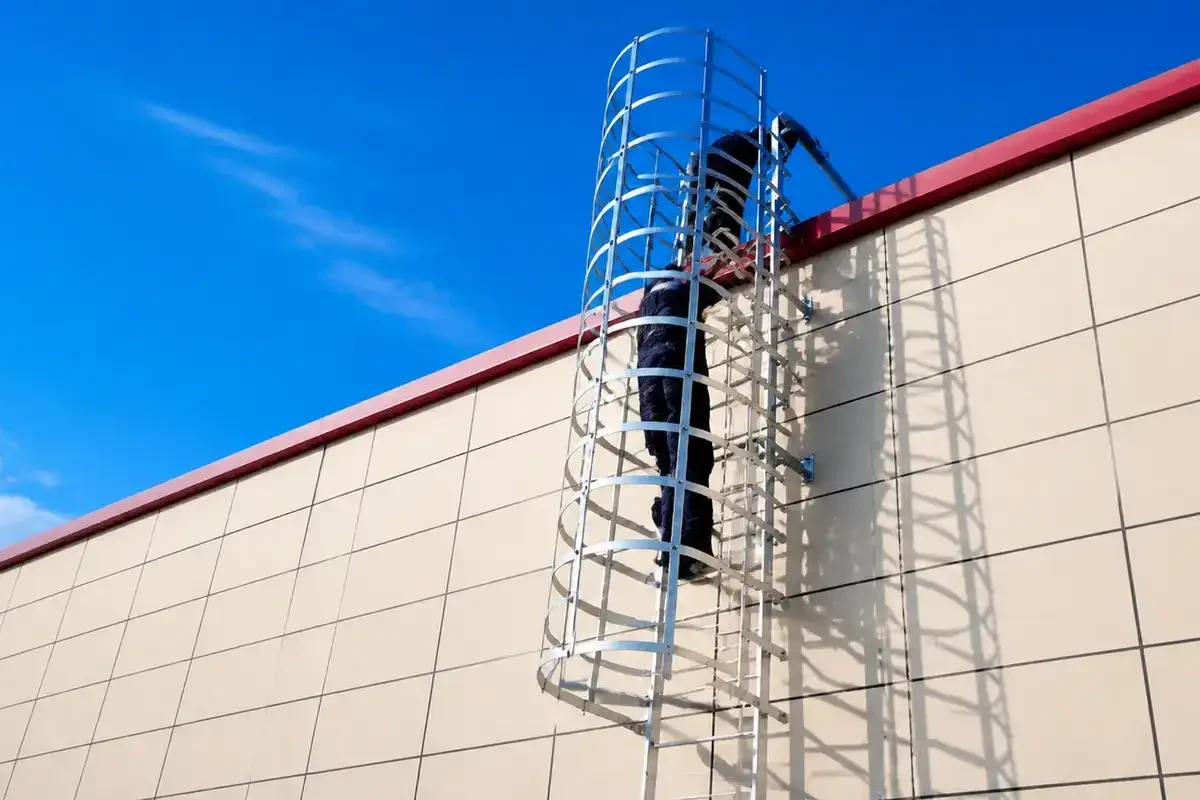
A systematic annual inspection is the most important maintenance activity for installed steel ladders. This checklist covers all critical inspection points for HDG, SS304, and SS316 fixed and caged ladders, aligned with OSHA 1910.23, EN ISO 14122-4, and AS 1657 inspection requirements.
Inspection Frequency
| Environment | Frequency | After Events |
|---|---|---|
| Indoor, dry, non-industrial | Every 2 years | — |
| Outdoor urban (C3) | Annually | After severe storms |
| Industrial (C4) | Annually | After major maintenance shutdowns |
| Coastal (C5-M) | Every 6 months | After tropical storms/hurricanes |
| Food processing | Annually | After washdown chemical changes |
| Water/wastewater | Every 6 months | After process upsets |
Part 1: Structural Integrity
1.1 Stile (Side Rail) Condition
- [ ] Visual inspection: No visible bending, bowing, or deformation of the side rails
- [ ] Section loss: No measurable reduction in cross-section compared to adjacent sections
- [ ] Corrosion: No pitting deeper than 0.5mm; no rust perforation
- [ ] Weld integrity: No cracks at stile-to-rung or stile-to-bracket welds (use dye penetrant or visual with flashlight)
- [ ] Straightness: Check with straight edge; deviation ≤3mm over 2m length
Fail if: Any visible crack, section loss >10% of original thickness, or permanent deformation.
1.2 Rung Condition
- [ ] All rungs present: Count rungs; no missing rungs
- [ ] Rung deformation: No bent, twisted, or loose rungs
- [ ] Rung surface: Anti-slip surface intact; no smooth or polished areas from wear
- [ ] Rung-to-stile connection: No movement when weight is applied; welds intact
- [ ] Rung spacing: Uniform spacing ±3mm throughout
Fail if: Any missing rung, any rung that moves under load, or rung surface worn smooth.
1.3 Safety Cage Integrity (Caged Ladders)
- [ ] All hoops present: Count hoops; no missing hoops
- [ ] Hoop deformation: No bent, crushed, or distorted hoops
- [ ] Vertical strap attachment: All straps attached at every hoop intersection
- [ ] Hoop spacing: Uniform; no gaps larger than 300mm
- [ ] Flared bottom section: Present and not obstructed
- [ ] Cage diameter: Maintained throughout; no sections collapsed inward
Fail if: Any missing hoop, hoop deformation reducing inside diameter below 650mm, or detached vertical straps.
1.4 Platform Condition (Where Applicable)
- [ ] Deck plate: No holes, corrosion perforation, or deformation
- [ ] Anti-slip surface: Grating or chequer plate pattern still effective
- [ ] Toe board: Present and securely attached on all open sides
- [ ] Handrail/guardrail: Present, secure, correct height (≥1,100mm)
- [ ] Drainage: No standing water on platform surface
- [ ] Connection to ladder: Secure bolted connection; no movement
Part 2: Bracket and Anchor System
2.1 Bracket Condition
- [ ] All brackets present: Count brackets against drawing; no missing brackets
- [ ] Bracket deformation: No bent or twisted bracket arms
- [ ] Bracket corrosion: No section loss >10%; no cracks at bend radii
- [ ] Bracket-to-ladder connection: All bolts present and tight; torque check on random sample
- [ ] Bracket spacing: Consistent with drawing; no span >2,000mm without intermediate bracket
2.2 Anchor Condition
- [ ] Anchor bolt presence: All anchor bolts in place; no missing or loose bolts
- [ ] Anchor bolt corrosion: No significant corrosion on bolt heads or exposed threads
- [ ] Anchor tightness: Torque check on random sample (≥10% of anchors); no bolts spinning
- [ ] Substrate condition: No cracking, spalling, or deterioration of concrete/brick around anchors
- [ ] Chemical anchor condition (if applicable): No evidence of chemical degradation, UV damage, or creep
Critical check: The top bracket (highest load) and bottom bracket (most exposed to ground moisture and impact) require special attention.
2.3 Thermal Expansion Accommodation
For ladders >10m:
- [ ] Sliding bracket connections: Check that slotted connections allow movement; no binding
Part 3: Corrosion and Coating Assessment
3.1 HDG Coating Assessment
- [ ] Overall appearance: Dull gray uniform coating; no large areas of rust staining
- [ ] Coating thickness: Measure at 3+ points per ladder section with digital gauge
- Pass: ≥45μm remaining
- Monitor: 20-45μm — plan recoating within 2 years
- Fail: <20μm — schedule recoating immediately
- [ ] Localized damage: Document and photograph any areas where coating has been mechanically damaged
- [ ] Cut ends: Check any field-cut ends for rust; apply zinc-rich touch-up if not previously treated
3.2 SS304/SS316 Assessment
- [ ] Tea staining: Light brown surface discoloration — cosmetic only, clean and monitor
- [ ] Pitting: Any visible pits — measure depth with pit gauge
- Pass: No pits deeper than 0.2mm
- Monitor: Pits 0.2-0.5mm — photograph and re-measure at next inspection
- Fail: Pits >0.5mm or clusters of pits — assess for structural impact
- [ ] Crevice corrosion: Inspect at all bolted joints, bracket connections, and cage strap-to-hoop contact points
- [ ] Weld corrosion: Inspect all welds for preferential corrosion
Part 4: Safety and Compliance
4.1 Dimensional Compliance
- [ ] Extension above landing: 1,067mm (OSHA) or 1,100mm (EN) — measure and record
- [ ] Bottom rung height: ≤610mm (OSHA) from finished ground level
- [ ] Cage bottom height: 2,100-2,400mm (7-8 ft) above ground (OSHA)
- [ ] Clearance behind rungs: ≥150mm
4.2 Accessories
- [ ] Warning signage: Present at base; legible; not obstructed
- [ ] Security door/gate: Present and functional; self-closing and self-latching
- [ ] Anti-slip nosing on top platform: Present and effective
- [ ] Fall arrest anchor point (if specified): Present; load-tested within past 12 months
4.3 Obstructions and Clearances
- [ ] Base area: Clear of stored materials, debris, vegetation
- [ ] Climbing path: No overhead obstructions within the cage or climbing envelope
- [ ] Landing area: Clear; handrails present where required
Part 5: Documentation
Record the following for each ladder:
| Field | Entry |
|---|---|
| Ladder ID/Location | |
| Inspection Date | |
| Inspector Name | |
| Ladder Model | |
| Installation Date | |
| Environment Category (C1-C5) | |
| Overall Condition | PASS / MONITOR / FAIL |
| Action Required | |
| Next Inspection Due | |
| Photographs Taken | Yes / No (attach) |
FAQ: Ladder Inspections
Q: What is the minimum inspection I must perform?
Visual inspection of all accessible components for obvious defects: missing parts, loose brackets, visible corrosion, bent components, and obstructions. This takes approximately 15 minutes per ladder and can be conducted by a competent maintenance person. Document the inspection even if no defects are found.
Q: What tools do I need for a thorough inspection?
Flashlight, digital camera/phone, inspection mirror (for viewing behind brackets), torque wrench (calibrated), coating thickness gauge (for HDG), pit depth gauge (for SS), measuring tape, straight edge (2m), and a copy of this checklist. A GoPro or phone video recording the climb is an excellent documentation method.
Q: What should trigger an immediate ladder quarantine?
Any of these findings should result in immediate barricading and lock-out until repaired: missing rung, cracked weld, anchor pull-out, bracket detachment, platform collapse, or any condition that would cause a person to fall.
Q: Can Dengtai review my inspection photos and provide an assessment?
Yes. Email your inspection photographs and notes to our engineering team. We provide a remote condition assessment at no charge for ladders originally supplied by Dengtai. For non-Dengtai ladders, assessment is provided as a paid service.
Q: How should I store inspection records?
Maintain a ladder inspection log (digital or physical) for the life of the ladder. Records should include: inspection date, inspector, findings, corrective actions taken, and photographs. These records demonstrate regulatory compliance and support insurance claims.
Related Resources
- Corrosion Repair Guide →
- When to Replace a Ladder →
- Ladder Corrosion Prevention →
- Ladder Inspection Checklist Blog →
- Maintenance Hub →
Download this checklist as a printable PDF. For Dengtai ladders, request a ladder-specific inspection checklist with your model’s reference dimensions.
Email: sales@dtsteelladder.com
WhatsApp: +86 155 1187 9488
****:(OSHA/EN/AS)。5:1(/<10%////);2(////);3(HDG>=45um20-45<20/SS304 SS316/>0.5mm//);4(//////12);5(ID//////)。。FAQ:///Dengtai/。
</script>
Not sure which solution fits your project?
Describe your facility and requirements — our engineers will match you to the right industry solution.
Talk to an Engineer →