Author: Jouth Zhao, Senior Engineer, Dengtai Staircase Manufacturing Co., Ltd. | Last updated: May 27, 2026 | Reading time: 9 min
International engineering projects frequently reference both OSHA 1910.23 and EN ISO 14122-4 in their fixed ladder specifications — sometimes in the same document. Understanding the differences between these two standards is essential for specifying ladders that comply with the governing standard in the project’s jurisdiction and for avoiding non-compliance during construction completion and regulatory inspection.
This comparison covers the dimensional, structural, and documentation requirements of each standard, identifies the key divergences that affect product specification, and provides practical guidance for international project managers and procurement professionals.
Standards at a Glance
| Attribute | OSHA 1910.23 | EN ISO 14122-4 |
|---|---|---|
| ———- | ————- | ————— |
| Full Title | 29 CFR 1910.23 — Ladders | Safety of Machinery — Permanent Means of Access to Machinery — Part 4: Fixed Ladders |
| Issuing Body | OSHA (Occupational Safety and Health Administration), US Department of Labor | CEN (European Committee for Standardization) / ISO (International Organization for Standardization) |
| Legal Status | US federal regulation — mandatory in all US states and territories | Harmonized European standard under Machinery Directive 2006/42/EC — provides presumption of conformity |
| Scope | All ladders in general industry workplaces | Fixed ladders forming part of machinery or providing access to machinery |
| Latest Revision | 2016 (effective 2017) | 2016 (EN ISO 14122-4:2016) |
| Geographic Application | United States | European Union, EEA, and globally adopted as international best practice |
Key Dimensional Comparison
| Parameter | OSHA 1910.23 | EN ISO 14122-4 | Dengtai Standard | Meets Both? |
|---|---|---|---|---|
| ———– | ————- | ————— | —————– | ———— |
| Rung width (min) | 16 in (406mm) | 400mm | 600mm | Yes — exceeds both |
| Rung spacing (max) | 12 in (305mm) | 300mm | 300mm | Yes — meets both |
| Rear clearance (min) | 7 in (178mm) | 150mm | 200mm | Yes — exceeds both |
| Side clearance (min, each side) | 15 in (381mm) | 200mm | 400mm | Yes — exceeds both |
| Top extension above landing | 42 in (1,100mm) | 1,100mm | 1,100mm | Yes — identical |
| Rung diameter (min) | Not specified (performance-based: prevent slipping) | 20mm (round rungs) | 20mm | Yes |
| Grab bar extension | 42 in (1,100mm) above landing | 1,100mm above landing | 1,100mm | Yes |
Key finding: For basic dimensional requirements, OSHA and EN are closely aligned. A ladder that meets EN dimensions will meet or exceed OSHA dimensions in almost every parameter. The divergence between the two standards is not in dimensions but in fall protection philosophy.
The Critical Difference: Fall Protection Philosophy
This is where OSHA and EN fundamentally differ. Understanding this difference is the single most important takeaway from this comparison.
OSHA 1910.23(d)(4) — Fall Protection
OSHA’s 2016 revision fundamentally changed the US approach to ladder fall protection:
- Before November 19, 2018: A cage or well was acceptable as the sole fall protection on fixed ladders over 24 feet (7.3m).
- After November 19, 2018 (new installations): All new fixed ladders over 24 feet must be equipped with a ladder safety system (vertical lifeline) or personal fall arrest system (PFAS). A cage alone is not sufficient.
- November 19, 2036 (deadline): All existing fixed ladders over 24 feet must be retrofitted with a ladder safety system or PFAS, regardless of installation date.
In other words: for new US installations, the cage changed from a fall protection system to a supplementary safety feature. The primary fall protection must be active — a lifeline and harness, not passive — a cage.
EN ISO 14122-4 — Fall Protection
EN takes a different approach:
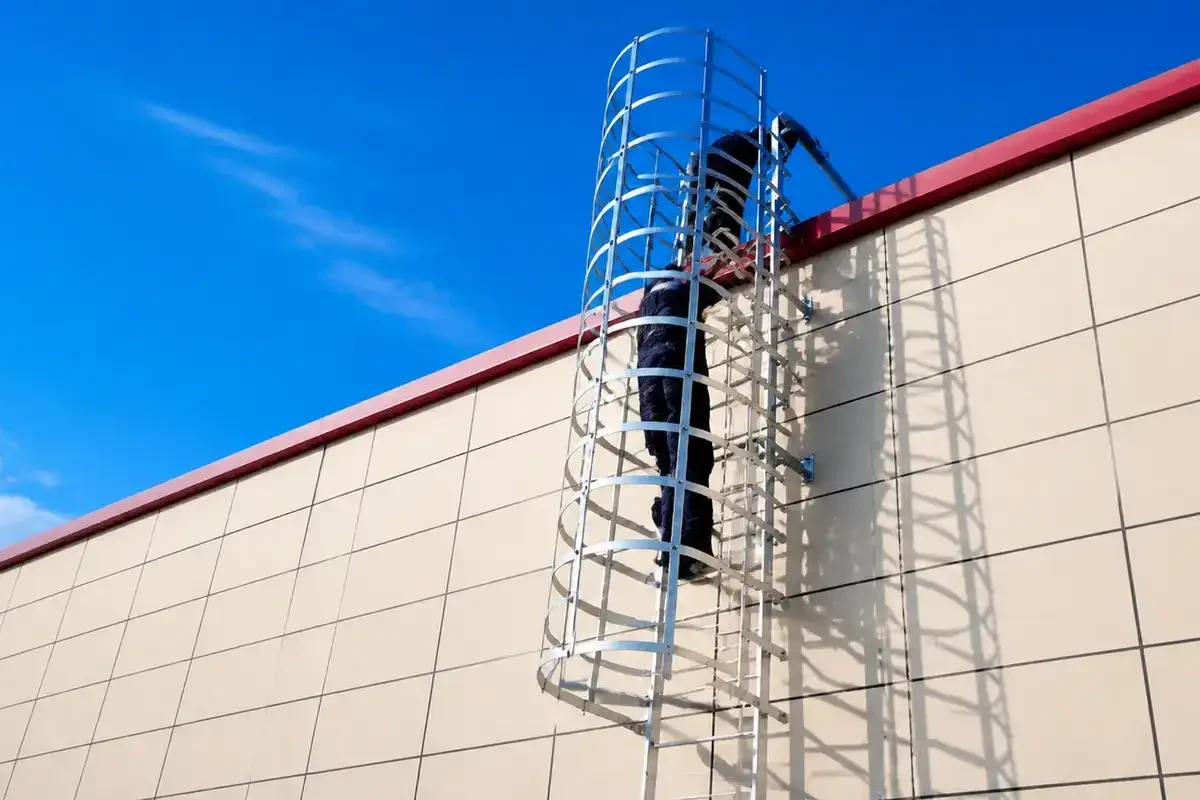
- A cage alone is sufficient as fall protection for fixed ladders at heights above 3m. There is no requirement for an active fall arrest system.
- The standard specifies cage dimensional requirements (hoop diameter, vertical spacing, clearance) that, when met, are considered adequate fall protection.
- EN does not mandate retrofitting of existing caged ladders with active systems.
The practical implication: If you specify a caged ladder for a US project and a caged ladder for a European project, the product can be identical. But for the US project, you must also supply a ladder safety system (or the employer must provide a PFAS). For the European project, the cage alone satisfies the requirement.
| Aspect | OSHA (Post-2018) | EN ISO 14122-4 |
|---|---|---|
| ——– | —————– | ————— |
| Cage as primary fall protection | No longer accepted for new ladders >24 ft | Accepted for all heights |
| Active fall arrest required | Yes — ladder safety system or PFAS required for >24 ft | No — cage is sufficient |
| Cage still useful? | Yes — as supplementary protection alongside active system | Yes — as primary fall protection |
| What this means for procurement | You need to budget for ladder safety systems on US projects | Your ladder + cage purchase is complete |
Cage Design Specifications
| Parameter | OSHA 1910.23(d)(4) | EN ISO 14122-4 §4.3.3.2 | Notes |
|---|---|---|---|
| ———– | ——————- | ———————— | ——- |
| Hoop inside diameter | 27-30 in (686-762mm) | Specified by calculation; typically 650-800mm | OSHA specifies a range; EN is performance-based |
| Hoop vertical spacing | Not directly specified (determined by strap configuration) | Max 300mm | EN is more prescriptive on spacing |
| Vertical straps | Min 5, equally spaced | Min 5, equally spaced | Both require 5 straps minimum |
| Bottom offset | 7-8 ft (2.1-2.4m) from base | Not specified; determined by design | OSHA specifies a range; EN leaves to design |
| Top extension | 42 in (1,100mm) minimum | 1,100mm minimum | Identical |
| Clearance inside cage | Not directly specified | Min 380mm from ladder centerline | EN specifies; OSHA relies on hoop diameter to ensure clearance |
Load Rating and Structural Requirements
| Parameter | OSHA 1910.23 | EN ISO 14122-4 |
|---|---|---|
| ———– | ————- | ————— |
| Load requirement | Capable of supporting max intended load without failure | 1.5 kN concentrated load per rung (design value) |
| Specific numerical rating | Not specified; 300 lbs per ANSI A14.3 industry interpretation | 1.5 kN (337 lbs) per rung |
| Safety factor | Not specified (performance-based) | Typically 1.5× per EN 1993 (Eurocode 3) for steel structures |
| Deflection limit | Not specified | Serviceability limit state per EN 1993 (typically L/200) |
Both standards require the ladder to support its design load without failure. OSHA’s performance-based language gives it flexibility; EN provides the specific numerical values engineers need for structural calculations.
Documentation Requirements
| Documentation | OSHA 1910.23 | EN ISO 14122-4 |
|---|---|---|
| ————– | ————- | ————— |
| Declaration of Conformity | Not explicitly required by OSHA; employer must ensure ladder meets standard | Required as part of CE/UKCA marking technical file |
| Manufacturer’s declaration | Employer may request as evidence of compliance | Essential component of the technical file |
| Material test certificates | Not OSHA-required but standard industry practice | Not explicitly required by EN but standard for CE marking |
| Weld inspection records | Not OSHA-required; employer responsible for ensuring ladder is safe | Implied by EN 1090 (execution of steel structures) |
| Dimensional conformance | Implied by compliance with 1910.23(d) | Required for CE marking technical file |
In practice, both OSHA and EN projects receive the same compliance documentation package from Dengtai because international buyers expect — and auditors require — the complete set regardless of which standard is formally referenced.
Which Standard Should Your Project Reference?
For projects in the United States: OSHA 1910.23 applies. You cannot substitute EN ISO 14122-4 for OSHA compliance at a US workplace. A ladder that is “EN compliant but not OSHA compliant” is non-compliant in the US.
For projects in the European Union: EN ISO 14122-4 applies as the harmonized standard. US-based EPC firms designing facilities in Europe should specify EN, not OSHA.
For projects in countries without a national ladder standard: EN ISO 14122-4 is the most commonly adopted international reference. Many Middle Eastern, Southeast Asian, and African projects specify “EN ISO 14122-4 or equivalent” in their technical requirements.
For projects referencing both standards: If your specification says “meet OSHA and EN,” Dengtai can provide a ladder that meets both. The dimensional requirements are aligned. The documentation package will reference both standards. We flag any conflict — typically only the fall protection approach (active vs cage-only) for ladders over 24 feet.
Working with Both Standards: Practical Tips
1. Specify the governing standard clearly in your inquiry. Tell your supplier: “Project in Houston, TX — OSHA 1910.23 applies” or “Project in Rotterdam, NL — EN ISO 14122-4 applies.” This ensures the correct documentation and any jurisdiction-specific dimensional requirements are applied.
2. If your project references both standards, clarify which one governs in case of conflict. For example: “Ladder dimensions per EN ISO 14122-4; fall protection per OSHA 1910.23.” This prevents the supplier from having to guess.
3. For ladders over 24 feet in the US, budget for ladder safety systems. The per-meter ladder cost ($23-30/m for HDG) is only part of the total. A vertical lifeline system adds approximately $200-400 per ladder depending on height and configuration. Include this in your project budget from the start.
4. Documentation packages are substantially the same. Whether your project is OSHA or EN, the material certs, weld reports, coating measurements, and dimensional reports are the same format. The Declaration of Conformity will reference the applicable standard(s).
Frequently Asked Questions
Is EN ISO 14122-4 accepted in the United States?
No. OSHA 1910.23 is the mandatory standard for US workplaces. An EN-compliant ladder is not a substitute for OSHA compliance. However, because Dengtai ladders meet the dimensional requirements of both standards, a ladder manufactured to EN dimensions is also dimensionally compliant with OSHA. The documentation must reference OSHA for US regulatory acceptance.
Which standard is more stringent?
OSHA is more stringent on fall protection (requiring active systems for new ladders >24 ft). EN is more prescriptive on dimensional specifications (explicit numerical values for hoop spacing, clearance, and rung dimensions that OSHA does not directly specify). Neither standard is categorically “more stringent” — they have different areas of emphasis.
Do I need different products for OSHA and EN projects?
In most cases, no. Dengtai’s standard ladder dimensions (600mm width, 300mm rung spacing, 200mm clearance, 1,100mm top extension) meet or exceed both standards. The same physical product can serve both markets. The difference is in the documentation (which standard is referenced in the Declaration of Conformity) and the fall protection system (required for new US ladders >24 ft).
How do I ensure my ladders will pass both OSHA and EN inspection?
Specify both standards when ordering. We will provide a dual-standard Declaration of Conformity and confirm that the product dimensions satisfy both. The only additional requirement for OSHA is the ladder safety system on ladders >24 ft.
How do I get a dual-standard quote?
Specify your project location and applicable standard(s) in your inquiry. Email sales@dtsteelladder.com or WhatsApp +86 155 1187 9488.
Specify the Right Standard for Your Project
OSHA. EN. AS. BS. We’ll ensure compliance with the correct standard.
Email: sales@dtsteelladder.com
WhatsApp: +86 155 1187 9488
Request a Quote → | OSHA 1910.23 Guide → | EN ISO 14122-4 Guide →
About the Author
Jouth Zhao is Senior Engineer at Dengtai Staircase Manufacturing Co., Ltd. He manages standards compliance for international projects across OSHA, EN, AS, and BS requirements, and has overseen compliance documentation for 500+ projects in 50+ countries.
Related Resources
- OSHA 1910.23 Complete Compliance Guide →
- EN ISO 14122-4 Complete Compliance Guide →
- Standards Compliance Hub →
- AS 1657 Compliance Guide →
- BS 4211 Compliance Guide →
>OSHA 1910.23 vs EN ISO 14122-4:——(//)、(24vs 3)、(42vs 1,100mm)、(300)、。AS 1657BS 4211。