Author: Jouth Zhao, Senior Engineer, Dengtai Staircase Manufacturing Co., Ltd. | Last updated: May 27, 2026 | Reading time: 8 min
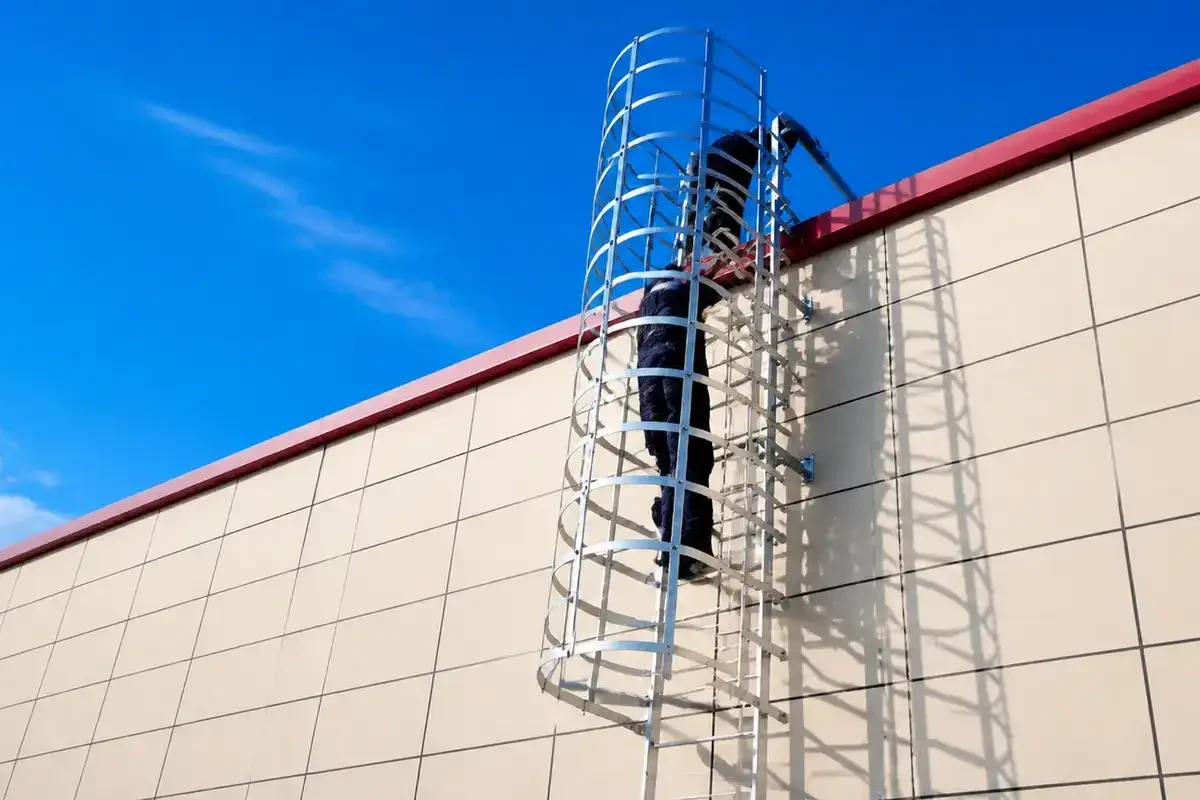
A cat ladder is a permanently fixed vertical ladder equipped with a safety cage (hoop guard), used for industrial and commercial building access. The term is standard in British English and is used throughout the United Kingdom, Singapore, Malaysia, Hong Kong, and other Commonwealth countries. It has nothing to do with cats or pet products — the name likely originates from the careful, agile movement required to climb a vertical ladder, similar to how a cat moves.
If you are a procurement manager, architect, or facilities engineer encountering the term “cat ladder” in a UK or Commonwealth project specification, this article explains exactly what it means, where the term comes from, what standards apply, and how it compares to similar ladder types.
Definition: What a Cat Ladder Is (and Is Not)
A cat ladder is an industrial fixed ladder. It is a permanent structure bolted to a wall, providing vertical access to roofs, platforms, mezzanines, or equipment. The defining feature is the safety cage — a series of circular steel hoops connected by vertical straps that surrounds the climbing path, providing passive fall protection.
A cat ladder is not:
- A portable ladder (step ladder or extension ladder)
- A pet product or animal-related item
- A roof ladder for roofing work (those are portable, hooked ladders, sometimes also called “cat ladders” in the UK roofing trade — this causes confusion)
- A stairway or staircase
The confusion with “roofing cat ladder” is important to address: some UK roofing contractors use “cat ladder” to describe a portable ladder with a ridge hook used for working on pitched roofs. However, in building specifications, construction tenders, and regulatory documents, “cat ladder” refers unambiguously to a fixed vertical ladder with a safety cage per BS 4211.
Origin of the Term “Cat Ladder”
The etymology of “cat ladder” is not definitively documented, but the most widely accepted explanation is that the term describes the action required to use one — climbing with the careful, deliberate movement of a cat. A narrow vertical ladder with a surrounding cage requires the climber to move steadily and attentively, qualities associated with feline movement.
Alternative theories include:
- Nautical origin: Ship rigging ladders (ratlines) were narrow and required cat-like agility; the term may have transferred to fixed land-based ladders.
- “Cat” as in “catwalk”: A catwalk is a narrow elevated walkway; a cat ladder provides access to a catwalk.
- Corruption of “catch ladder”: Possibly a corruption of earlier terminology describing a ladder that “catches” (stops) a fall.
Whatever the origin, the term has been established in British building terminology for over a century. In 2026, if a UK architect writes “cat ladder” on a drawing, every contractor knows exactly what is meant.
For a deeper exploration of the terminology’s history and regional variations, read: Why Do British People Call It a Cat Ladder?
Regional Usage: Where “Cat Ladder” Is the Standard Term
| Country / Region | Standard Term | Governing Standard |
|---|---|---|
| —————– | ————– | ——————- |
| United Kingdom | Cat Ladder | BS 4211:2005+A1:2008 |
| Singapore | Cat Ladder | BS 4211 / SS 588 |
| Malaysia | Cat Ladder | BS 4211 / MS 1593 |
| Hong Kong | Cat Ladder | BS 4211 / Code of Practice for Means of Access |
| Australia | Fixed Ladder (sometimes Cat Ladder in legacy documents) | AS 1657 |
| United States | Caged Ladder / Fixed Ladder | OSHA 1910.23 |
| Canada | Fixed Ladder with Cage | CSA Z259.2 |
Practical implication for procurement: If you are importing ladders from a Chinese manufacturer, you must use the correct terminology for your market to ensure the supplier applies the correct standard. Order a “cat ladder” and the supplier should reference BS 4211 dimensions (500mm width). Order a “caged ladder” and the supplier should reference OSHA/EN dimensions (600mm width). See Dengtai’s global terminology guide for a complete cross-reference.
BS 4211: The British Standard for Cat Ladders
BS 4211:2005+A1:2008 governs the specification for permanently fixed ladders in the UK. It defines requirements for:
| Parameter | BS 4211 Specification | CT-HDG-STD Value |
|---|---|---|
| ———– | ———————- | ——————- |
| Width | Minimum clear width specified for safe climbing | 500mm |
| Rung spacing | Uniform, maximum specified | 300mm |
| Safety cage | Hoop diameter and vertical spacing specified | 800mm diameter, 300mm spacing |
| Load rating | Static load capacity per rung | 300 lbs (136 kg) |
| Material | Corrosion-protected structural steel | Q235B HDG (≥80μm) |
| Fixing | Bracket spacing and anchor requirements | ≤2.0m bracket spacing |
For the complete regulatory requirements, including the Work at Height Regulations 2005, read: Cat Ladder Regulations UK
Cat Ladder vs Caged Ladder vs Fixed Ladder — What Is the Difference?
The three terms describe structurally similar products, but with different regional and regulatory implications.
| Aspect | Cat Ladder | Caged Ladder | Fixed Ladder (No Cage) |
|---|---|---|---|
| ——– | ———– | ————- | ———————- |
| Region | UK, Singapore, Malaysia, Hong Kong | North America, Middle East, Global | All regions |
| Standard | BS 4211 | OSHA 1910.23 / EN ISO 14122-4 | OSHA 1910.23 / EN ISO 14122-4 |
| Has safety cage? | Yes (by definition) | Yes (by definition) | No (cage optional below 7.3m per OSHA) |
| Typical width | 500mm | 600mm | 600mm |
| Term used in specs | “Cat ladder” | “Caged ladder” | “Fixed ladder” |
For a more detailed comparison: Cat Ladder vs Cage Ladder — Full Comparison
Typical Applications for Cat Ladders
Cat ladders are specified for permanent vertical access in the following building types, particularly in UK/Commonwealth markets:
- Commercial office buildings — roof access for HVAC maintenance and building services
- Industrial facilities — platform, mezzanine, and equipment access in factories
- Water treatment plants — tank top access, deep well access
- Educational buildings — plant room access on university and school campuses
- Residential towers — roof access for lift motor rooms and mechanical plant
- Telecommunications facilities — antenna and equipment platform access
Explore Roof Access Applications →
Material and Corrosion Protection
Cat ladders are almost always specified in hot-dip galvanized steel due to their permanent outdoor installation. The galvanizing process immerses the fabricated steel ladder in molten zinc at approximately 450°C, producing a metallurgically bonded coating of 80-100μm thickness.
| Material | Typical Lifespan (UK Climate) | Maintenance |
|---|---|---|
| ———- | —————————- | ———— |
| Hot-Dip Galvanized (Q235B, ≥80μm) | 15-25 years | Visual inspection every 2 years |
| Stainless Steel 304 | 30+ years | Occasional cleaning |
| Stainless Steel 316 | 50+ years | Minimal — specified for coastal/chemical environments |
For coastal locations (within 5km of the sea), Dengtai recommends upgrading to SS316, which provides resistance to chloride-induced pitting corrosion that can compromise galvanized coatings in marine atmospheres.
How to Specify a Cat Ladder for Your Project
When writing a specification or sending an inquiry, include these key parameters:
1. Terminology — Use “cat ladder” explicitly to signal UK/Commonwealth standards.
2. Height — Vertical distance from base mounting point to top landing (add 1,100mm for the extension above the landing).
3. Material — HDG standard; specify SS304 or SS316 if the environment requires it.
4. Standard — Reference BS 4211:2005+A1:2008.
5. Wall construction — Brick, concrete, structural steel, or other (affects bracket and anchor selection).
6. Quantity — Number of identical units.
Example specification sentence:
> “Supply and install one cat ladder to BS 4211:2005+A1:2008, hot-dip galvanized finish, 5.8m overall height including top extension, fixed to masonry wall at maximum 2.0m bracket centres.”
Frequently Asked Questions
Is a cat ladder the same as a caged ladder?
Yes, structurally. “Cat ladder” is the British English term; “caged ladder” is the American English term. Both refer to a fixed vertical ladder with a safety cage. The terminology difference is important for regulatory compliance — a “cat ladder” implies BS 4211, while a “caged ladder” implies OSHA or EN standards.
Why do British building specifications use the term “cat ladder” instead of “caged ladder”?
Because BS 4211, the governing British Standard, uses the term “cat ladder” (or “fixed ladder” in the standard’s formal language). Decades of UK construction contract language have embedded the term. Using “caged ladder” on a UK specification would be understood but is technically the wrong regional term.
Is a cat ladder the same as a roof ladder used by roofers?
No. A roofing “cat ladder” (also called a roof ladder) is a portable aluminium ladder with a ridge hook, used temporarily by roofers working on pitched roofs. An industrial “cat ladder” is a permanently fixed steel ladder with a safety cage. Context determines which is meant — building specifications use the industrial definition.
Does BS 4211 apply to projects outside the UK?
BS 4211 is directly referenced by building codes in Singapore, Malaysia, and Hong Kong. Other Commonwealth countries may reference BS 4211 or local equivalents (AS 1657 in Australia). For non-Commonwealth countries, the equivalent standard (OSHA 1910.23, EN ISO 14122-4) should be used instead.
How much does a cat ladder cost?
Dengtai’s CT-HDG-STD cat ladder is quoted on a per-project basis. Factors affecting price include overall height, quantity, material, and destination. As a reference, a standard 6m HDG fixed ladder is $138 FOB, and a 6m HDG caged ladder is $180 FOB. Cat ladders are quoted individually based on the specification. Contact sales@dtsteelladder.com for a project-specific quote. See our steel ladder pricing guide for detailed cost breakdowns.
Can I use a cat ladder in a project outside the Commonwealth?
Technically yes, but you would be using the wrong terminology for your market. If the project is in North America, refer to our caged ladders. If it is in continental Europe, use fixed steel ladders per EN ISO 14122-4. The product can be manufactured to the applicable local standard regardless of what you call it.
Conclusion
A cat ladder is a fixed vertical ladder with a safety cage, standard in UK and Commonwealth building specifications per BS 4211. When specifying or procuring, the term triggers the correct standard and dimensional requirements for these markets. Dengtai manufactures BS 4211 compliant cat ladders from HDG steel with full compliance documentation and factory-direct pricing.
About the Author
Jouth Zhao is Senior Engineer at Dengtai Staircase Manufacturing Co., Ltd. He has over 20 years of experience in steel fabrication and has overseen the design and production of fixed access ladders for 500+ projects across 50+ countries. Contact: jouth.zhao@dtsteelladder.com.
Related Resources
- Cat Ladders Product Page →
- Caged Ladders Product Page →
- BS 4211 Compliance Guide →
- Cat Ladder vs Cage Ladder — Detailed Comparison →
- Cat Ladder Regulations UK →
- Why Do British People Call It a Cat Ladder? →
Need a Cat Ladder for Your Project?
BS 4211 compliant. UK/Commonwealth standard. Factory-direct pricing.
>(Cat Ladder)?/:BS 4211,caged ladder。BS 4211、、////。