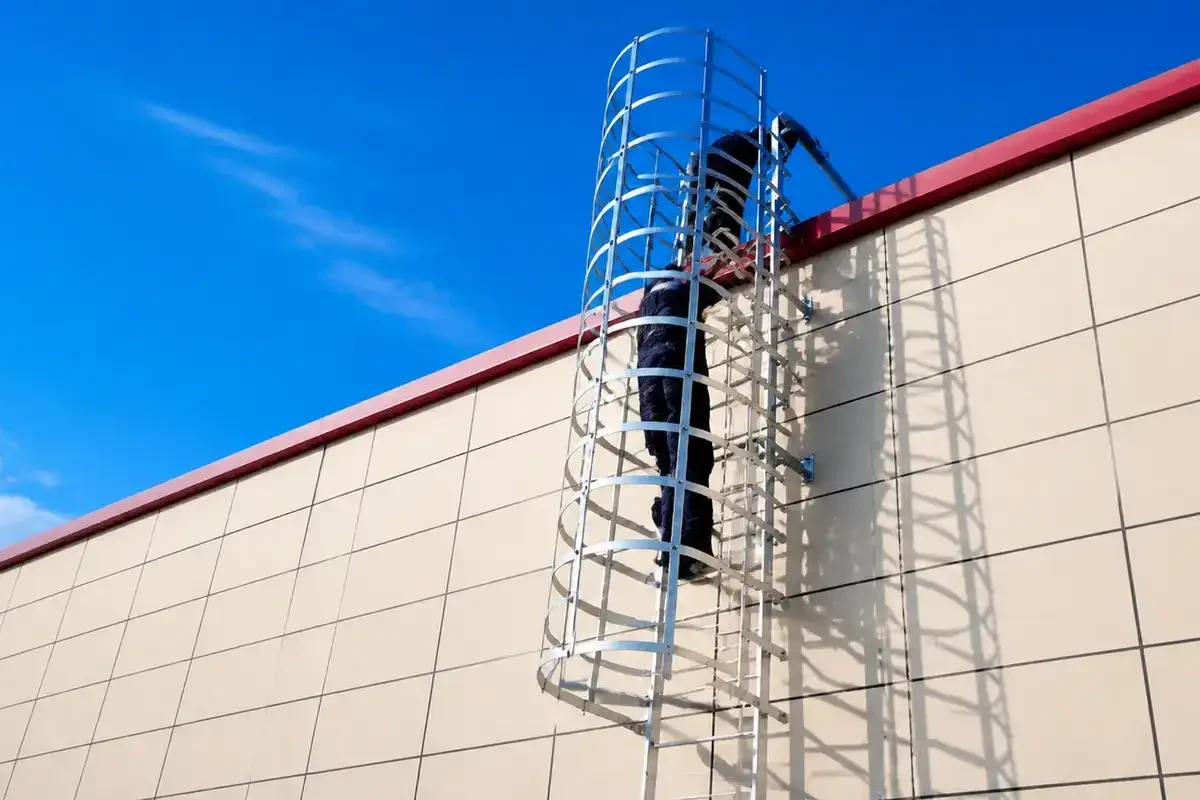
A caged ladder (cat ladder in UK/Commonwealth markets) combines a fixed vertical ladder with a hoop guard safety cage. This guide covers the specification parameters unique to caged ladders — cage geometry, section configuration, platform requirements, and the OSHA 2036 compliance considerations.
Specification Parameters
1. Height and Section Configuration
| Height | Section Configuration | Intermediate Platforms |
|---|---|---|
| 2-6m | Single section | None required |
| 6-10m | Two sections (3-6m each) | 1 platform at the section joint |
| 10-15m | Three sections | 2 platforms |
| 15-20m | Four sections | 3 platforms |
| Over 20m | Engineered solution | Per structural requirements |
Each section is 3-6m long with flanged bolt-together connections. Intermediate platforms provide rest points and section transitions.
2. Cage Geometry
Standard cage: 800mm inside diameter, 300mm hoop spacing, 5 vertical straps. The cage begins at 2,200mm above the base and extends 1,100mm above the landing. These dimensions meet or exceed OSHA, EN, and AS requirements.
Custom cage options: Larger diameter for climbers in bulky PPE, square cage for confined riser shafts, partial cage for specific structural configurations.
3. Material Selection
| Material | Cost/m | Applications |
|---|---|---|
| HDG Q235B | $30/m | General industrial, outdoor non-coastal |
| HDG Q345B | Custom | Heavy-duty, steel mill, mining, crane access |
| SS304 | $77/m | Food, pharmaceutical, visible architectural, mild coastal |
| SS316 | $115/m | Coastal, offshore, chemical plant, water treatment |
4. Platform Requirements
Intermediate landing platforms include: galvanized steel grating (40% open area), guardrail (1,100mm top rail + intermediate rail + 100mm toe board), self-closing safety gate to prevent falls from the platform edge.
OSHA 2036 Compliance for Caged Ladders
For new caged ladders installed in the US after November 19, 2018, and exceeding 24 feet (7.3m):
A cage alone is NOT sufficient. OSHA 1910.23(d)(4) requires a personal fall arrest system or ladder safety system in addition to the cage.
Dengtai offers integrated ladder safety systems (vertical lifeline with cable sleeve) as an option on all caged ladder models. Specify this requirement at the time of inquiry. The lifeline can be factory-installed or supplied as a kit for on-site installation.
Multi-Section Installation Overview
- Each section arrives pre-assembled with matching flanged connection plates
- Wall brackets are installed at 2.0m maximum intervals
- The bottom section is lifted into position and bolted to brackets
- Successive sections are lifted, aligned, and bolted to the section below via the flanged joints
- Intermediate platforms bolt to the ladder stiles and are independently supported by the wall structure
- The top extension is verified to provide 1,100mm above the landing
- All bolted connections are torqued to specification and verified
Required Information for Quotation
- Total vertical height (base to landing)
- Number of sections (or we calculate based on height)
- Material (HDG, SS304, SS316)
- Project location (for applicable standard and destination)
- OSHA ladder safety system required? (for US projects >24 ft)
- Accessories — Safety gate, anti-climb shield, lockable security door
- Wall type — For correct anchor specification
- Special requirements — Custom cage diameter, color matching, seismic anchoring
Price Reference
| Model | Material | Price (USD/m FOB Tianjin) |
|---|---|---|
| CL-HDG-STD | HDG Q235B | $30.00 |
| CL-HDG-MULTI | HDG Q235B | $30.00 |
| CL-HDG-HD | HDG Q345B | Custom quote |
| CL-SS304-STD | SS304 | $77.00 |
| CL-SS316-STD | SS316 | $115.00 |
Frequently Asked Questions
When is a cage NOT required on a ladder?
The cage requirement threshold varies by standard. OSHA 1910.23(d)(4): no cage required below 24 ft (7.3m). EN ISO 14122-4 section 4.3.3: no cage below 3m. AS 1657: no cage below 4m. BS 4211: cage required where fall risk exceeds approximately 2.5m, determined by risk assessment. Even when a cage is not legally required, many safety-conscious projects specify cages on all fixed ladders — the marginal cost of adding a cage is approximately $7/m (comparing FL-HDG-STD at $23/m to CL-HDG-STD at $30/m).
What is the difference between OSHA 1910.23 cage requirements and the OSHA 2036 update?
OSHA 1910.23(d)(4) requires a cage for fixed ladders exceeding 24 ft. However, OSHA published a final rule in 2016 (effective November 19, 2018) requiring that all NEW fixed ladders over 24 ft must use a ladder safety system or personal fall arrest system — a cage alone is no longer sufficient. Existing caged ladders must be retrofitted with a safety system by November 19, 2036. For any US project with ladders exceeding 24 ft, specify the ladder safety system option at inquiry.
Can I get a caged ladder with an integrated ladder safety system?
Yes. Dengtai offers a factory-installed vertical lifeline system (cable sleeve type) as an option on all caged ladder models. The lifeline rail mounts to the ladder stile and is compatible with our standard CL series. Specify this requirement when requesting a quotation for US projects exceeding 24 ft.
What cage diameter options are available?
Standard: 800mm inside diameter (meets OSHA and EN). Custom: 760mm for AS 1657 compliance (Australia enforces a maximum 760mm ID per section 4.4.3), larger diameters (up to 1,000mm) for climbers in bulky PPE or confined space rescue equipment, square cages for confined riser shafts where circular hoops would not fit.
How are multi-section caged ladders assembled on site?
Each section (3-6m) arrives pre-assembled with flanged connection plates at both ends. On site: wall brackets are installed at 2.0m maximum spacing. The bottom section is lifted, aligned, and bolted to brackets. Successive sections are lifted and the flanged joints are bolted together (structural bolts, torque to specification). Intermediate platforms bolt to the ladder stiles and are independently supported by the wall structure. Full assembly typically takes 2-4 hours for a 12m two-section ladder with a 3-person crew.
Real-World Project Examples
The following Dengtai case studies demonstrate how proper specification and material selection deliver successful outcomes:
Thailand Petrochemical (2022) — 43 HDG caged ladders (CL-HDG-MULTI) and 12 platform sets for the PTT Global Chemical cracking unit. Multi-section caged ladder configuration specified for access to elevated pipe racks and vessel platforms. Full EN ISO 14122-4 cage compliance required.
Singapore Marina Bay (2023) — 16 SS304 caged ladders (CL-SS304-STD) for rooftop mechanical plant access at a premium coastal development. Cages specified for safety on 4-6 story access ladders in a publicly accessible commercial building. SS304 selected for aesthetic requirements and Singapore’s humid marine environment.
Malaysia RAPID Refinery (2020) — 35 heavy-duty caged ladders (CL-HDG-HD, Q345B) for the PETRONAS RAPID integrated refinery. Heavy-duty cages (700mm width, Q345B material, >100um HDG) specified for refinery process unit access. DNV classification society inspection on all caged ladder assemblies.
These projects are documented in full in our Case Studies section. Each includes project background, technical challenges, solution details, and quantified results.
Compliance Standards Reference
Dengtai manufactures to the following international access standards. Each standard has specific dimensional and documentation requirements:
| Standard | Jurisdiction | Cage Required Above | Key Clause |
|---|---|---|---|
| OSHA 1910.23 | United States | 24 ft (7.3m) | 1910.23(d)(4) — ladder safety systems |
| OSHA 1910.27 | United States | N/A (scaffolds) | 1910.27(b)(1) — load rating 4x intended load |
| EN ISO 14122-4 | European Union | 3m | Section 4.3.3 — safety cage requirements |
| AS 1657 | Australia | 4m | Section 4.4.3 — cage dimensions max 760mm ID |
| BS 4211 | United Kingdom | ~2.5m (risk-based) | Section 4 — cat ladder specification |
| ANSI A14.3 | United States | Per OSHA | Section 5 — fixed ladder design requirements |
For US projects: OSHA 1910.23(b)(8) specifies rung spacing maximum 305mm (12 inches). Our standard 300mm spacing meets this. OSHA 1910.23(d)(4)(iv) requires top extension of 1,100mm (42 inches) above the landing surface. Always add this to your measured climbing height.
For EU projects: EN ISO 14122-4 section 4.3.2 specifies cage hoop diameter maximum 800mm and hoop spacing 300mm maximum. Our standard 800mm diameter with 300mm spacing meets both EN and OSHA requirements simultaneously.
For Australian projects: AS 1657 section 4.4.3 specifies cage inside diameter maximum 760mm. Note this differs from EN/OSHA’s 800mm. If your project’s Australian AHJ enforces the 760mm limit, specify AS 1657 cage diameter when ordering.
For UK projects: BS 4211 section 4 defines cat ladder specifications including 500mm standard width (narrower than OSHA/EN 600mm). UK clients should specify “cat ladder” to receive BS 4211 compliant dimensions.
Industry-Specific Ladder Selection Guidance
Oil & Gas
Environment: Atmospheric corrosion (H2S, SOx), potential hydrocarbon exposure, fire risk considerations.
Material: HDG Q235B for inland facilities. SS316 for coastal or sour service (H2S present). Q345B heavy-duty for high-traffic operator access routes.
Standard: OSHA 1910.23 (US projects), EN ISO 14122-4 (non-US), operator technical standards (Shell DEP, Total GS, PETRONAS PTS).
Recommended products: CL-HDG-MULTI for tall structures, CL-SS316-STD for coastal/offshore, CL-HDG-HD for high-traffic routes.
Case reference: Thailand PTT Chemical (43 HDG ladders, EN compliance), Malaysia PETRONAS RAPID (35 heavy-duty ladders, DNV certified).
Power Generation
Environment: High ambient temperature near boilers, coal dust (coal-fired), potential fly ash exposure, vibration from rotating equipment.
Material: HDG Q235B for general plant access. Q345B for areas with vibration or heavy tool traffic. SS304 where coal dust + humidity creates acidic conditions.
Standard: Typically EN or OSHA depending on project finance source. EPC contractor specifications often reference both.
Recommended products: CL-HDG-MULTI for boiler and chimney access (tall structures), FL-HDG-EXT for cooling tower access.
Case reference: Vietnam EVN Vinh Tan (28 platforms + 16 ladders, EN compliance).
Water & Wastewater Treatment
Environment: High humidity, H2S (hydrogen sulfide) in confined wet wells, chlorine and chemical dosing areas, submerged or splash zone exposure.
Material: SS316 (EN 1.4401) is the standard recommendation for any environment with H2S exposure. SS304 may be adequate for above-ground structures without chemical exposure. HDG is NOT recommended for any confined wet well application — failure within 2-3 years.
Standard: Typically EN or local standard. Municipal projects may have specific corrosion protection specifications.
Recommended products: CL-SS316-STD / FL-SS316-STD for all wet well and chemical area access. Acid passivation treatment on all SS316 components.
Case reference: Philippines Maynilad (22 SS316 deep well ladders, acid passivation treatment, H2S-resistant specification).
Commercial Buildings
Environment: Urban atmospheric exposure, aesthetic requirements (visible ladder must look acceptable), public safety considerations.
Material: HDG for non-visible areas (mechanical rooms, rear access). SS304 where ladders are visible from public areas or street-facing elevations. SS316 for coastal city locations.
Standard: Local building code (IBC in US, NCC in Australia) in addition to OSHA/EN access standards. Fire escape requirements may apply.
Recommended products: CL-HDG-STD for utility access, FL-SS304-STD for visible exterior, CL-SS304-STD for premium developments.
Case reference: Singapore CapitaLand Marina Bay (16 SS304 caged ladders, #240 brushed finish for architectural consistency).
Manufacturing & Industrial
Environment: Varies by industry — general manufacturing (dry, clean), chemical manufacturing (corrosive), food/beverage (washdown, hygienic), electronics (cleanroom).
Material: HDG for general manufacturing. SS304 for food/beverage/pharma (hygienic, washdown-compatible). SS316 for chemical manufacturing.
Standard: OSHA 1910.23 (US), EN ISO 14122-4 (EU/global), plus industry-specific (FDA, GMP, HACCP for food).
Recommended products: FL-HDG-STD for general mezzanine access, CL-SS304-STD for food/pharma, FL-SS316-STD for chemical areas.
Case reference: Indonesia Murata Electronics (52 platforms + 18 ladders, cleanroom-compatible SS304, vibration control specification).
Marine & Offshore
Environment: Salt spray, wave splash, direct saltwater immersion (splash zone), UV exposure, wind loading up to hurricane/typhoon force.
Material: SS316 is the minimum recommendation for any marine application. SS304 will pit within 10-20 years. HDG will fail within 3-5 years. For splash zone or submerged applications, duplex stainless steel (UNS S32205) may be required.
Standard: Classification society rules (DNV, Lloyd’s Register, ABS, Bureau Veritas) in addition to OSHA/EN. NORSOK for Norwegian sector. Operator-specific offshore standards.
Recommended products: CL-SS316-STD for jetty and dock access, custom duplex SS for splash zone. All fasteners must be SS316 minimum. Avoid any carbon steel components.
Documentation: Classification society material certification, NDT (non-destructive testing) reports, welder qualification records, coating system certification.
Welding Quality and Inspection Standards
All Dengtai steel ladders are welded to ISO 5817 Quality Level C (general structures) or Level B (stringent) depending on the project specification. Our welders are qualified to ISO 9606-1 for carbon steel and ISO 9606-1 for stainless steel.
Weld Inspection Protocol:
- Pre-weld: Joint preparation check, fit-up verification, pre-heat if required (thick sections, Q345B in cold weather)
- In-process: Root pass inspection on structural joints, interpass temperature control for stainless steel (max 150degC for SS304/316)
- Post-weld: Visual inspection per ISO 17637 (100% of welds), dimensional check of weld profile, spatter removal on stainless
- NDT (if specified): Dye penetrant testing (PT) per ISO 3452-1 for stainless steel surface-breaking defects, magnetic particle testing (MT) per ISO 17638 for carbon steel, ultrasonic testing (UT) per ISO 17640 for full penetration structural welds
- Documentation: Weld map identifying each welder by joint number, WPS (Welding Procedure Specification) reference, inspection results per weld
Common Weld Defects and Prevention:
| Defect | Cause | Prevention |
|———|——-|———–|
| Porosity | Contaminated surface, moisture, gas flow issue | Clean joint surfaces, dry electrodes, proper gas coverage |
| Lack of fusion | Low heat input, travel speed too high | Correct amperage setting, slower travel speed |
| Undercut | Excessive current, incorrect electrode angle | Adjust parameters, correct technique |
| Spatter (SS) | Incorrect shielding gas, wire feed | 98% Ar + 2% CO2 or 98% Ar + 2% O2 mix for stainless |
| Distortion | Unbalanced welding sequence, excessive heat | Alternate sides, stitch weld where permitted, jig restraint |
Surface Treatment Details
Hot-Dip Galvanizing (HDG) Process
- Degreasing: Remove oil, grease, and shop dirt from fabrication
- Pickling: Hydrochloric acid bath removes mill scale and rust
- Fluxing: Zinc ammonium chloride solution pre-coats the surface
- Hot dipping: Immersion in molten zinc at 450degC. The zinc metallurgically bonds to the steel forming Fe-Zn alloy layers
- Quenching: Water quench for rapid cooling, or air cooling for thicker coatings
- Inspection: Coating thickness measured per ISO 2808 (magnetic method). Target: >80um average, no single reading <56um per ISO 1461
HDG Advantages: Complete coverage (internal and external surfaces), metallurgical bond resists mechanical damage, sacrificial protection (zinc corrodes preferentially), 15-25 year life in non-coastal environments, zero maintenance.
Stainless Steel Passivation
- Pre-cleaning: Remove all surface contamination (grease, weld spatter, carbon steel pickup)
- Acid treatment: Nitric acid or citric acid bath removes free iron from the surface
- Passivation: The acid treatment enriches the chromium oxide passive layer that gives stainless steel its corrosion resistance
- Rinse: Deionized water rinse to remove all acid residue
- Verification: Copper sulfate test or ferroxyl test confirms passivation effectiveness
For SS316 in aggressive environments (H2S, chloride), we recommend full pickling and passivation per ASTM A380.
Anchor and Bracket Engineering
The connection between ladder and structure is the critical load path that transfers climber weight, wind load, and seismic forces to the building.
| Wall Type | Anchor System | Edge Distance | Embedment |
|---|---|---|---|
| Reinforced concrete (>C25) | SS316 expansion anchor (Hilti HST3 or equivalent) | >100mm from edge | >60mm |
| Unreinforced brick/block | Chemical anchor (epoxy resin + threaded rod) | >150mm from edge | >80mm |
| Structural steel column | Through-bolt with backing plate, or beam clamp | N/A | N/A |
| Light-gauge steel cladding | Through-bolt to structural frame behind cladding | N/A | N/A |
| Hollow CMU | Screen tube + chemical anchor (epoxy fills the void) | >150mm | Through-wall |
For seismic zones (IBC Seismic Design Category C and above), contact engineering for seismic restraint design. Additional anchors or engineered bracing may be required.
Total Cost of Ownership (TCO) Methodology
When comparing ladder options, consider the total lifecycle cost, not just the purchase price:
TCO = Purchase Price + Freight + Installation + (Annual Maintenance x Years) + Replacement Cost
Example calculation for a 6m caged ladder, coastal environment, 30-year period:
| Cost Element | HDG Q235B | SS316 |
|---|---|---|
| Purchase (6m x $/m) | $180 | $690 |
| Ocean freight (est.) | $80 | $80 |
| Installation | $250 | $250 |
| Annual maintenance | $0 | $0 |
| Replacements | 3 x $510 = $1,530 | 0 |
| 30-Year TCO | $2,040 | $1,020 |
The SS316 ladder costs 50% less over 30 years despite a 3.8x higher purchase price. This is the most common procurement error: optimizing for capital expenditure (purchase price) while ignoring operational expenditure (replacement cost).
For non-coastal environments where HDG achieves 20+ year life, HDG delivers lowest TCO. See our Buyer’s Guide: Materials for the environment-based selection matrix.
Next Steps
Email: sales@dtsteelladder.com
WhatsApp: +86 155 1187 9488
Request a Quote → | View Caged Ladders → | Download Spec Sheet →
</script>
Not sure which solution fits your project?
Describe your facility and requirements — our engineers will match you to the right industry solution.
Talk to an Engineer →