<nav aria-label=”Breadcrumb”>
Home » Industry Deep-Dives » <strong>Water Treatment</strong>
</nav>
Water Treatment Ladders — SS316 Corrosion-Resistant Access Solutions
Water and wastewater treatment facilities combine some of the most aggressive corrosion conditions in any industry: chlorine gas and sodium hypochlorite from disinfection, hydrogen sulfide (H2S) from anaerobic wastewater decomposition, sulfuric acid and caustic soda from pH adjustment, and — for coastal plants — salt-laden marine air. The result is a multi-mechanism corrosion environment where a single material must resist chlorides (pitting), sulfides (stress cracking), acids (general corrosion), and high humidity (atmospheric corrosion) simultaneously.
Dengtai supplied 22 SS316 deep well caged ladders and 14 platforms for Maynilad Water Services in Metro Manila, Philippines (2023) — a project where standard galvanized ladders from a previous supplier had failed within 6-8 years due to combined chlorine + H2S + tropical humidity attack. The Maynilad case validated SS316 as the minimum acceptable material for water industry applications with chemical exposure.
Industry Pain Points
Combined chemical attack defeats single-mechanism material selection. A ladder specified for chlorine resistance (SS304) fails from H2S stress cracking. A ladder specified for H2S resistance (SS316, solution annealed) may still pit if chloride concentrations are elevated. A ladder specified for general corrosion (HDG) fails rapidly from combined chlorine oxidation and H2S acid attack. The water treatment environment requires material selection that accounts for ALL chemical species present, not just the dominant one.
Confined space access multiplies replacement cost. Deep well access ladders, clarifier tank ladders, and chemical dosing pit ladders are in confined spaces. Ladder replacement requires: confined space entry permit, atmospheric monitoring for H2S/O2/LEL, ventilation setup, specialized rescue standby team, and in many cases, process shutdown. The cost of replacement — including safety compliance, labor, and production downtime — exceeds the original ladder cost by 5-10x. Specifying the correct material at initial installation avoids this entire cost stream.
HDG has a short service life in water treatment. An 80-micron HDG coating that lasts 15-25 years in a dry indoor industrial environment typically fails within 5-10 years in a water treatment plant. Chlorine, H2S, and pH adjustment chemicals all attack the zinc layer. Once the zinc is consumed at local defects — around bolt holes, at weld heat-affected zones, or at coating damage from installation — the underlying carbon steel corrodes rapidly in the wet environment.
Coastal water plants add marine corrosion to chemical attack. Desalination plants, coastal wastewater treatment facilities, and seaside pumping stations combine the chemical environment of water treatment with the chloride-rich marine aerosol of the coast. This dual attack demands SS316 at minimum. SS304 will pit from marine chloride exposure. SS316’s molybdenum content provides the necessary combined resistance.
Recommended Ladder Solutions
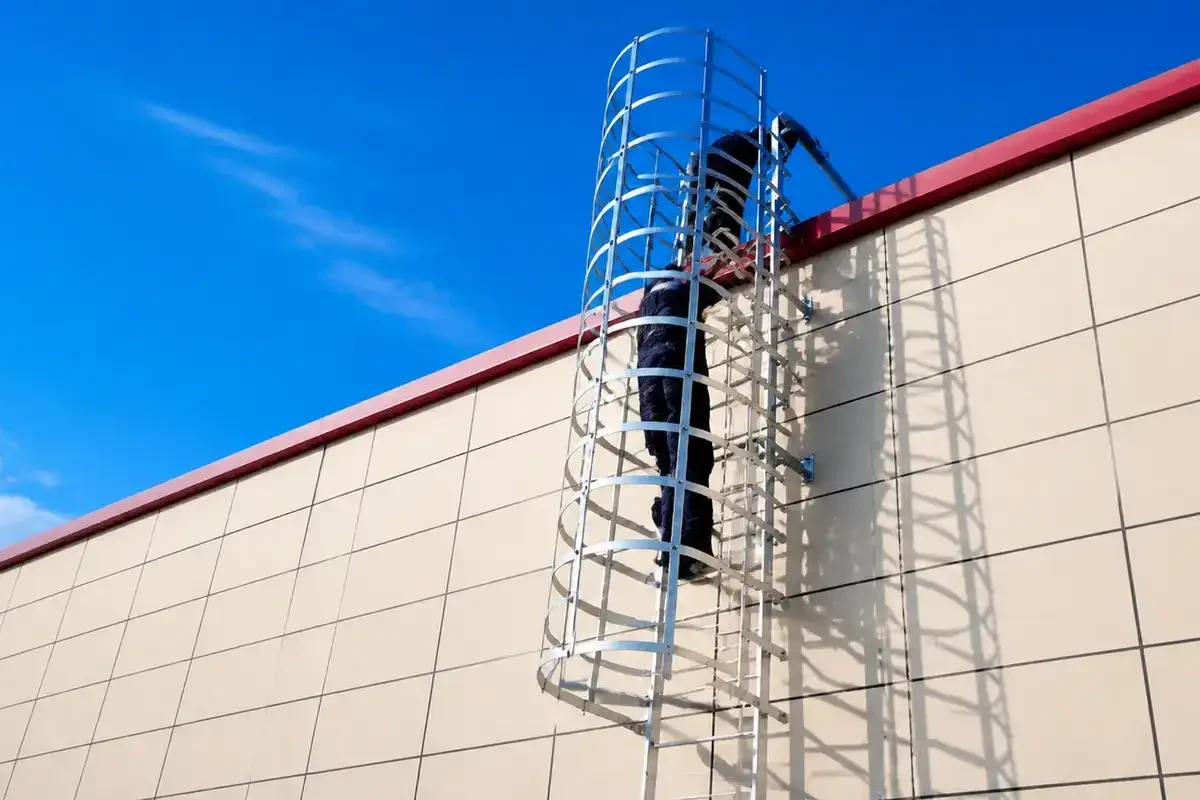
CL-SS316-STD Stainless Caged Ladder — Water Industry Standard
Best for: Deep well access, chemical dosing areas, clarifier and sedimentation tank access, coastal desalination plants, and any location with chemical exposure. This is the standard-grade product for water and wastewater applications.
Specifications: SS316 (EN 1.4401), acid pickled + passivated finish. Continuous ground-smooth welds. All-SS316 fasteners. Factory-fitted lifeline mounting brackets for confined space fall arrest systems. Standoff brackets (1,200mm) available for well casing clearance.
Price: $115.00/m.
View CL-SS316-STD →
FL-SS316-STD Stainless Fixed Ladder — Short Access and Non-Caged
Best for: Short access points where height is below the cage threshold (<3m per EN, <4m per AS). Chemical dosing platform access, valve pit access, sump access.
Specifications: SS316, same material grade and finish as caged variant.
Price: $73.00/m.
View FL-SS316-STD →
CL-SS304-STD Stainless Caged Ladder — Non-Chemical Areas
Best for: Administration buildings, maintenance workshops, non-process storage areas within the water treatment plant perimeter where chemical exposure is absent.
Specifications: SS304 (EN 1.4301), 240# brushed + passivated finish.
Price: $77.00/m.
View CL-SS304-STD →
CS-ENG Duplex 2205 Custom — Extreme Coastal + Chemical
Best for: Coastal desalination plants, seawater intake structures, brine outfall access, and locations where the combined chloride + chemical environment exceeds SS316’s pitting resistance threshold (PREN 24-26).
Specifications: Duplex 2205 (EN 1.4462), PREN 34-36.
Price: Custom quote (approximately 2-3x SS316 cost).
View Custom Engineering →
Material Selection by Treatment Process Zone
| Zone | Chemical Environment | Material | Recommended Model |
|---|---|---|---|
| Raw water intake | Variable water quality; potential H2S in raw water | SS316 | CL-SS316-STD |
| Chemical dosing (chlorine, NaOH, H2SO4, polymer) | Concentrated chemical exposure; spill risk | SS316 | FL-SS316-STD / CL-SS316-STD |
| Coagulation / flocculation | Alum, ferric chloride (acidic) | SS316 | CL-SS316-STD |
| Sedimentation / clarification | Settled solids, residual chemicals | SS316 | CL-SS316-STD |
| Filtration (sand, membrane) | Treated water, lower chemical concentration | SS304 or SS316 | Per plant specification |
| Disinfection (chlorine, UV, ozone) | Chlorine gas, sodium hypochlorite — highly oxidizing | SS316 essential | CL-SS316-STD |
| Sludge handling | H2S from anaerobic decomposition; high humidity | SS316 | CL-SS316-STD |
| Deep well / groundwater access | H2S, high humidity, confined space | SS316 | CL-SS316-STD with lifeline bracket |
| Coastal desalination plant (all zones) | Marine aerosol + process chemicals | SS316 or Duplex 2205 | Per zone assessment |
| Administration / workshop | No chemical exposure | SS304 or HDG | FL-HDG-STD / FL-SS304-STD |
Chemical Resistance Reference
| Chemical | Typical Use in Water Treatment | Effect on HDG | Effect on SS304 | Effect on SS316 |
|---|---|---|---|---|
| Chlorine gas (Cl2) | Primary disinfection | Rapidly corrodes zinc | May pit with prolonged wet contact | Good resistance (dry); contact engineering for wet |
| Sodium hypochlorite (NaOCl) | Disinfection, odor control | Corrodes zinc | Moderate — may pit with prolonged contact | Good resistance |
| Hydrogen sulfide (H2S) | Present in wastewater, groundwater | Attacks zinc; forms zinc sulfide | Potential sulfide stress cracking | Good resistance; NACE MR0175 compliance for sour service |
| Sulfuric acid (H2SO4) | pH adjustment | Rapidly attacks zinc | No (SS304 not resistant) | Limited (dilute, ambient temp) |
| Sodium hydroxide (NaOH) | pH adjustment, CIP cleaning | Corrodes zinc | Good resistance | Good resistance |
| Ferric chloride (FeCl3) | Coagulant | Rapidly corrodes zinc | Pitting from chlorides | Good resistance |
| Aluminum sulfate (alum) | Coagulant | Moderately corrosive (acidic) | Good resistance | Excellent resistance |
| Hydrochloric acid (HCl) | Membrane cleaning, pH adjustment | Rapidly attacks zinc | No | No (contact engineering) |
| Ozone (O3) | Disinfection | Attacks zinc | Good resistance in dry conditions | Good resistance |
Case Study: Maynilad Water Services, Philippines (2023)
Client: Maynilad Water Services, Inc. (Manila water concessionaire serving over 9 million people in the western Metro Manila concession area).
Project: Deep well access at wastewater treatment and pumping facilities across Metro Manila.
Scope: 22 CL-SS316-STD deep well caged ladders + 14 platform sets.
Challenge: Deep well access shafts (8-15m depth) in an aggressive multi-mechanism corrosion environment: (a) chlorine from water disinfection processes; (b) hydrogen sulfide from anaerobic decomposition in wastewater collection; (c) sodium hypochlorite from odor control dosing; (d) tropical humidity exceeding 80% year-round; (e) proximity to Manila Bay adding marine aerosol chloride. Standard galvanized steel ladders from a previous supplier had failed within 6-8 years — pitting corrosion at rung-to-stile welds, crevice corrosion at bracket connections, and general coating degradation on side rails. The confined-space nature of deep well access made ladder replacement extremely costly: confined space entry permit, continuous H2S/O2/LEL monitoring, mechanical ventilation setup, specialized rescue team standby, and partial facility shutdown during replacement work.
Solution: 22 CL-SS316-STD caged ladders manufactured with acid pickled + passivated finish. All connections were continuously welded and ground smooth — no stitch welds, no crevices, no unsealed joints. All-SS316 fasteners throughout the entire assembly including brackets, bolts, nuts, washers, and anchor bolts (zero dissimilar metal contact to prevent galvanic corrosion). Ladders were installed with 1,200mm standoff brackets to maintain clearance from the corrosive well casing surface and allow visual inspection access behind the ladder. PTFE insulating gaskets at the interface between SS316 bracket plates and the carbon steel wellhead support structure to prevent galvanic corrosion of the structural steel. Factory-fitted vertical lifeline mounting brackets for integration with the facility’s confined space fall arrest and retrieval system.
Result: Zero corrosion at the 12-month and 24-month scheduled inspections. The Maynilad engineering team standardized on SS316 for all future well access and treatment process ladder procurement across their facility network. The project demonstrated that the initial material cost premium for SS316 (versus HDG or SS304) was recovered within the first avoided replacement cycle.
Frequently Asked Questions
SS304 or SS316 for water treatment — how do I decide?
SS316 if your facility handles: chlorine disinfection (gas or hypochlorite), wastewater with H2S generation, any chemical dosing with chloride-containing chemicals (ferric chloride, hydrochloric acid), or is located within 5km of the coast. SS304 may be acceptable only in treated-water areas with no chemical exposure, and only if the plant is inland. When uncertain, specify SS316 — the price premium of SS316 over SS304 is approximately 40-50%, which is trivial compared to the cost of a single replacement in a confined space.
How long do SS316 ladders last in water treatment?
25-30 years with appropriate installation. The Maynilad ladders showed zero corrosion at 24 months. Properly passivated SS316 with continuous welds and all-SS316 fasteners should serve the design life of the facility without replacement. The key to longevity is eliminating crevices (continuous welds, not stitch), eliminating dissimilar metal contact (all-SS316 fasteners), and passivating the surface after fabrication.
Do I need NACE MR0175 compliance for water treatment ladders?
Only if the H2S concentration and partial pressure exceed the sour service threshold defined in NACE MR0175/ISO 15156 (H2S partial pressure > 0.05 psi / 0.3 kPa). Most municipal water treatment applications do not reach this threshold. However, some industrial wastewater treatment and anaerobic digestion applications may. Provide your H2S monitoring data for assessment.
Can I use HDG in non-process areas of the water treatment plant?
Yes — in administration buildings, maintenance workshops, and warehouse areas that are physically separated from treatment processes and have no chemical exposure risk. HDG must not be used in any area with detectable chlorine, H2S, or process chemical fumes.
How do I get a quote for water treatment ladders?
Provide: treatment process description, chemical species present (chlorine, H2S, coagulants, etc.), ladder locations and heights, confined space designation if applicable, and coastal proximity. For deep well access, provide the well casing material and internal diameter. Email sales@dtsteelladder.com or WhatsApp +86 155 1187 9488.
Water Treatment Ladder Solutions
SS316 standard. Confined space lifeline brackets included. Continuous welds, all-SS316 fasteners. Maynilad Philippines project reference. Deep well, clarifier, chemical dosing, and coastal desalination applications.
Email: sales@dtsteelladder.com | WhatsApp: +86 155 1187 9488
Request a Quote → | View Stainless Steel Ladders → | Custom Engineering →
</script>
Not sure which solution fits your project?
Describe your facility and requirements — our engineers will match you to the right industry solution.
Talk to an Engineer →