Author: Jouth Zhao, Senior Engineer, Dengtai Staircase Manufacturing Co., Ltd. | Last updated: May 27, 2026 | Reading time: 5 min
Fixed ladders are among the most frequently used access equipment in industrial facilities — and among the most taken for granted. These 10 safety practices, grounded in OSHA guidance and engineering experience, reduce the risk of falls and injuries when using fixed and caged ladders.
1. Maintain Three Points of Contact
Always have two hands and one foot, or two feet and one hand, in contact with the ladder. This means:
- Don’t carry tools in your hands — use a tool belt or hoist line
- Don’t rush — each rung, one at a time
- Face the ladder during both ascent and descent
2. Inspect Before Every Use
A 30-second visual inspection before climbing:
- Rungs — any that are bent, loose, or excessively worn?
- Brackets — any loose bolts or cracked welds?
- Cage — any bent hoops that could snag clothing?
- Anchors — any rust staining indicating water ingress?
- Surrounding area — any new obstructions or hazards?
Report any issues immediately. Don’t use a damaged ladder.
3. Know the Load Rating
Standard Dengtai ladders are rated for 300 lbs (136 kg) — the climber plus clothing, tools, and equipment. Heavy-duty models are rated for 450 lbs (204 kg). Never exceed the rated load. The load rating is marked on the ladder nameplate.
4. Use a Ladder Safety System When Required
For ladders over 24 ft in US workplaces (post-November 2018 installations), a ladder safety system (vertical lifeline) or personal fall arrest system is required by OSHA. The cage alone is not sufficient. Ensure the lifeline is inspected, the sleeve moves freely, and all users are trained.
5. Keep the Cage Clear
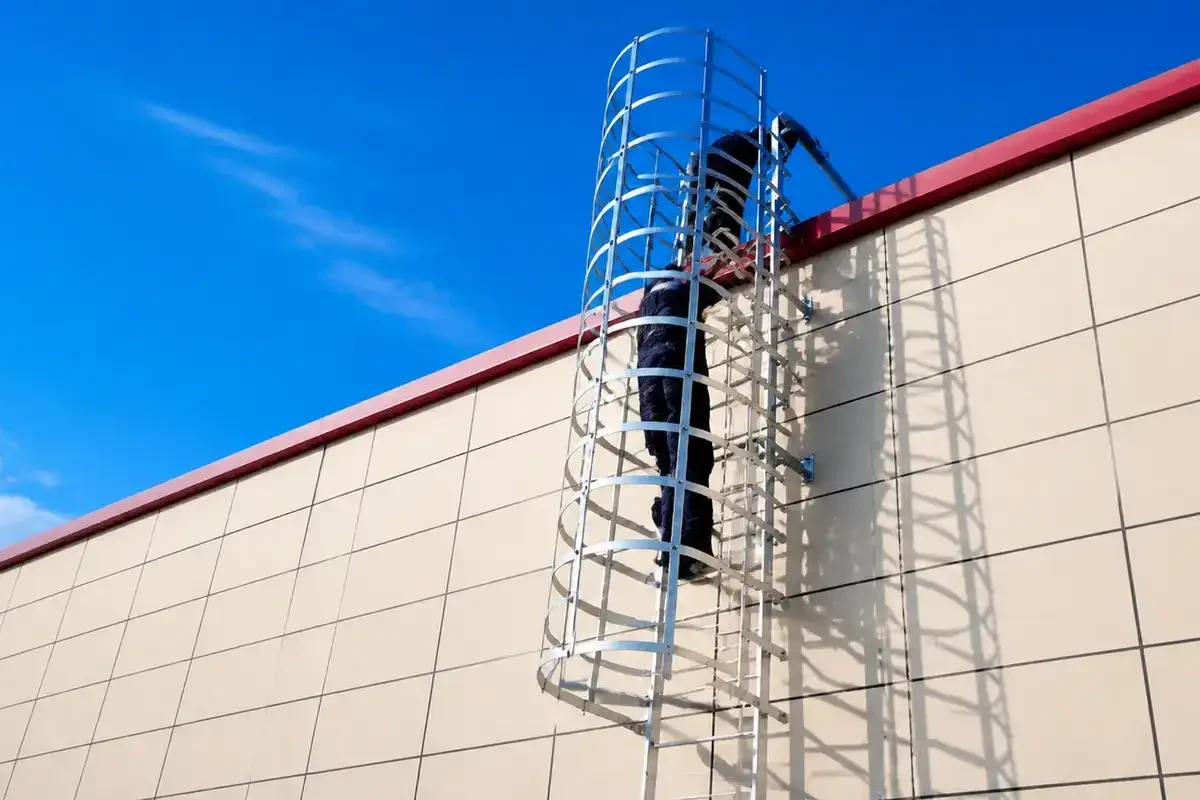
Caged ladders rely on the hoop guard to contain a backward fall. The cage must be:
- Free of stored materials (pipes, tools, hoses draped through hoops)
- Structurally intact (no bent or missing hoops)
- Not used as a cable or pipe support (damages hoops and creates climb obstruction)
6. Check the Top Landing
The transition from ladder to landing is a high-risk moment. Ensure:
- The safety gate is present and self-closing
- The landing is clear of obstructions, ice, oil, or debris
- Guardrails at the landing are intact (top rail, intermediate rail, toe board)
- Adequate lighting is present at the landing
7. Wear Appropriate Footwear
Non-slip soles on closed-toe safety shoes provide the grip needed on steel ladder rungs. Avoid:
- Leather-soled dress shoes (slippery on steel)
- Sandals or open-toe footwear
- Shoes with mud, oil, or grease on the soles
8. Be Aware of Weather Conditions
Outdoor ladders present additional hazards:
- Rain: Wet rungs are slippery — climb slower, maintain firmer grip
- Ice/snow: Clear ice and snow from rungs and cage before climbing. Consider restricting access in icy conditions.
- Wind: Tall caged ladders catch wind. Climb with caution in winds exceeding 30 mph (48 km/h). The cage provides some wind shelter but does not eliminate wind force.
- Heat: Steel ladders in direct sun can reach 60-70°C surface temperature. Wear gloves if climbing in high heat.
9. Never Modify a Ladder Without Engineering Review
Do not:
- Weld additional brackets, platforms, or attachments to the ladder without engineering assessment
- Cut, drill, or notch any structural member
- Remove cage hoops or vertical straps
- Substitute non-original anchor bolts or bracket components
Any modification can compromise structural integrity and void the warranty. Contact the manufacturer for any intended modification.
10. Report and Document
Every incident, near-miss, or safety concern related to a fixed ladder should be:
- Reported immediately to the site safety officer
- Documented in the site safety log
- Investigated for root cause
- Addressed with corrective action
A near-miss with a ladder is a free lesson — learn from it before it becomes an incident.
Facility Manager’s Checklist
- [ ] All ladders are labeled with load rating and inspection date
- [ ] Annual formal inspection is scheduled and documented
- [ ] Ladder safety systems (where installed) are inspected per manufacturer requirements
- [ ] Users are trained on ladder safety procedures
- [ ] Spare parts (rungs, brackets, gate springs) are maintained in inventory
- [ ] Inspection records are retained for the ladder’s service life
Frequently Asked Questions
1. Is three-point contact really necessary on a caged ladder?
Yes. The cage is a passive fall protection device — it catches you if you fall backward. It does not prevent a fall caused by losing grip or footing. Three-point contact (two hands and one foot, or two feet and one hand) is your active fall prevention. The cage is your backup. Relying on the cage instead of maintaining three-point contact is like driving without a seatbelt because your car has airbags.
2. How often should fixed ladders be formally inspected?
OSHA does not specify an exact inspection interval — it requires inspection “on a periodic basis” as determined by the employer. Industry best practice is annual formal inspection for outdoor installations, bi-annual for indoor installations in non-aggressive environments, and quarterly for ladders in corrosive or high-use environments. The key is documenting the inspection and the inspection criteria. Use our Ladder Inspection Checklist as a starting point.
3. What should I do if I find a damaged ladder?
Immediately tag it as “DO NOT USE” with a visible, weatherproof tag at the base. Report it to the site safety officer. Barricade the ladder base if there is any risk of someone ignoring the tag. Contact the manufacturer for repair or replacement guidance — do not attempt structural repairs (welding, straightening bent stiles) without an engineering assessment. A bent stile that appears repairable may have microscopic cracks that will propagate under load.
Author: Jouth Zhao, Senior Engineer
View Safe Ladders → | Ladder Inspection Checklist →
About the Author
Jouth Zhao is Senior Engineer at Dengtai Staircase Manufacturing Co., Ltd. He has developed ladder safety training materials for industrial clients across 50+ countries and regularly consults on fixed ladder safety program implementation for manufacturing and processing facilities.
Related Articles
- Ladder Inspection Checklist — OSHA-Compliant Inspection Procedure
- Ladder Fall Protection Systems — Complete Guide
- Fixed Ladder Requirements OSHA — What You Must Know
- Caged Ladders Product Page
>:① ②30 ③(300/450) ④24 ⑤ ⑥ ⑦ ⑧/// ⑨ ⑩。。