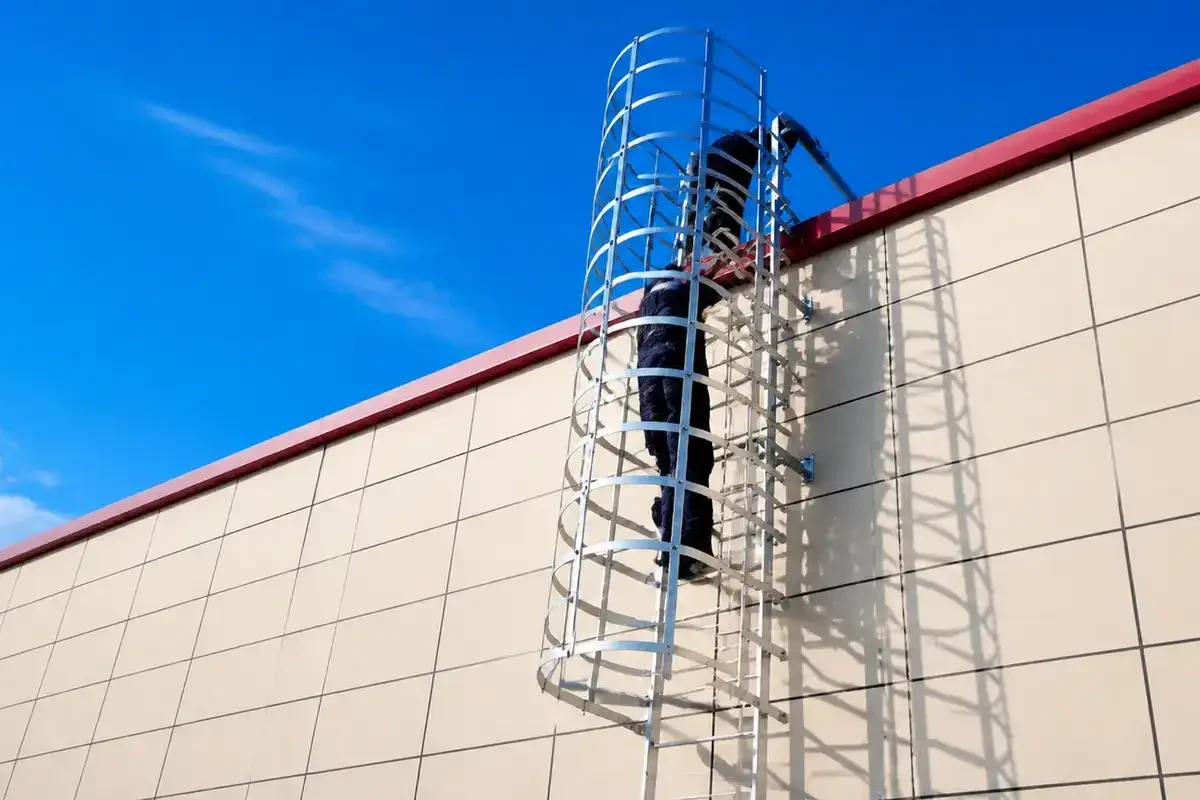
Every Dengtai steel ladder passes through a five-step production process inside our 3,000m² factory in Shijiazhuang, Hebei. This page walks you through that process — from raw steel entering the facility to the finished ladder packed for export in a VCI-wrapped wooden crate.
Our annual capacity of 1,500 tonnes supports both standard model production and custom engineering projects. Standard models (FL-HDG-STD, CL-HDG-STD, and their stainless steel equivalents) ship within 15-20 working days. Custom and bulk orders require 30-45 working days depending on complexity.
Factory Tour: Step by Step
Step 1: Raw Material Receiving & Inspection
All raw material enters through a single receiving bay where it is inspected before acceptance into inventory.
| Material Check | Method |
|---|---|
| Mill test certificate (MTC) | Verified against the steel mill’s original certificate — chemical composition (C, Mn, Si, S, P for carbon steel; Cr, Ni, Mo for stainless) and mechanical properties (yield strength, tensile strength, elongation) |
| Dimensional check | Section dimensions (flat bar thickness/width, round bar diameter) measured with calibrated instruments |
| Visual inspection | Surface condition checked for mill scale, pitting, lamination, or transport damage |
| Stainless steel PMI | Positive Material Identification (PMI) using handheld XRF analyzer — confirms SS304 vs SS316 grade before the material enters production |
Material that does not match its certificate or shows defects is quarantined and returned to the supplier. This is the first and most critical quality gate — if the steel is wrong, everything that follows is wrong.
Materials in inventory:
- Q235B carbon steel: flat bar (65mm × 10mm for side rails), round bar (20mm diameter for rungs), flat bar (40mm × 5mm for cage straps)
- Q345B high-strength steel: flat bar and round bar for heavy-duty models
- SS304 (EN 1.4301): flat bar, round bar, plate
- SS316 (EN 1.4401): flat bar, round bar, plate
Step 2: Cutting, Drilling & Preparation
Steel sections are cut to length using CNC saws (band saw for thick sections, cold saw for precision cuts). Rung mounting holes are CNC-drilled in the side rails to ensure consistent 300mm spacing with ±2mm tolerance. Cage hoop segments are rolled to the 800mm diameter on a plate rolling machine.
| Process | Equipment | Tolerance |
|---|---|---|
| Side rail cutting | CNC band saw | ±2mm on length |
| Rung cutting | CNC cold saw | ±1mm on length |
| Rung hole drilling | CNC drilling machine | ±0.5mm on position, 300mm ±2mm spacing |
| Cage hoop rolling | 3-roll plate bending machine | 800mm ±5mm diameter |
| Cage strap cutting | Guillotine shear | ±2mm on length |
Step 3: Welding & Fabrication
Welding is the structural core of every ladder — every rung-to-side-rail joint, every hoop-to-strap connection, and every bracket-to-rail attachment is a welded joint. Dengtai welds to ISO 5817 quality standards:
- Carbon steel (Q235B/Q345B): MIG (GMAW) welding using ER70S-6 filler wire. Quality Level C (general structures) per ISO 5817 — no cracks, no lack of fusion, no surface pores exceeding specified limits. Each weld is visually inspected by the welder and spot-checked by QC.
- Stainless steel (SS304/SS316): TIG (GTAW) welding using ER308L (for SS304) or ER316L (for SS316) filler rod. Quality Level B (stringent) per ISO 5817 — more demanding than Level C, reflecting the critical nature of corrosion resistance at welds. Low-carbon filler material prevents chromium carbide precipitation (sensitization) at grain boundaries.
| Weld Quality Requirement | Acceptable | Not Acceptable |
|---|---|---|
| Cracks | None permitted | Any crack = reject |
| Lack of fusion | None permitted | Any lack of fusion = reject |
| Surface porosity | Individual pores ≤0.5mm, no clusters | Cluster of pores or single pore >0.5mm |
| Undercut | ≤0.5mm depth, continuous length ≤25mm | Deeper or longer undercut |
| Weld profile | Smooth transition to parent metal; no sharp notches | Sharp notch at weld toe; excessive reinforcement |
All welders are qualified to the relevant welding procedure specification (WPS). Welder qualification records are maintained and available for project documentation.
Step 4: Surface Treatment
Surface treatment determines the ladder’s corrosion resistance and service life. Dengtai applies three surface treatment processes depending on the material:
Hot-Dip Galvanizing (Q235B/Q345B)
Carbon steel ladders are hot-dip galvanized to a minimum 80μm coating thickness (100μm for heavy-duty models). The process:
- Degreasing — Removes cutting oils and fabrication residues from the steel surface
- Acid pickling — Removes mill scale and surface oxides using hydrochloric acid
- Fluxing — Applies a zinc ammonium chloride flux solution that prepares the steel surface for zinc adhesion
- Hot-dip immersion — The ladder section is immersed in molten zinc at approximately 450°C (842°F). The zinc metallurgically bonds with the steel, forming zinc-iron alloy layers topped with a pure zinc outer layer
- Quenching and inspection — The ladder is cooled in a water quench and inspected for coating uniformity. Coating thickness is measured at 5+ points per ladder using a digital gauge
The hot-dip galvanizing is performed by a qualified subcontractor located within our industrial park, minimizing transport handling between the factory and the galvanizing facility. Our QC team inspects every batch upon return.
Stainless Steel Passivation (SS304)
After welding, SS304 ladders receive:
- 240# grit brushing — Uniform directional grain applied to all visible surfaces
- Nitric acid passivation — Immersion in nitric acid solution restores the chromium oxide passive layer (removed during welding) that gives stainless steel its corrosion resistance
- Anti-fingerprint treatment — A transparent coating that prevents visible fingerprint marks on the brushed surface
Stainless Steel Pickling + Passivation (SS316)
SS316 ladders receive the more aggressive treatment required for marine and chemical environments:
- Acid pickling — Immersion in nitric/hydrofluoric acid mixture removes weld heat tint, chromium-depleted surface layer, and any embedded iron particles from fabrication tooling
- Nitric acid passivation — Restores the full chromium oxide passive layer
- Final rinse and inspection — Visual check for uniform matte grey finish with no remaining heat tint
Step 5: Pre-Assembly, Inspection & Packaging
Before packaging, every ladder undergoes pre-assembly verification:
| Check | Method |
|---|---|
| Dimensional conformance | Total length, width, rung spacing, cage hoop spacing measured against order specification |
| Bracket fitment | Brackets test-fitted to ensure holes align with side rail mounting positions |
| Cage assembly | Hoops and vertical straps checked for alignment and security |
| Multi-section alignment | Sections test-assembled at flanged joints to verify bolt hole alignment |
| Surface finish | Visual inspection and coating thickness measurement |
Packaging protocol:
-
VCI wrap — Each ladder or ladder section is wrapped in VCI (Volatile Corrosion Inhibitor) paper or film. VCI releases molecules that form a microscopic protective layer on metal surfaces, preventing corrosion during sea transit — especially important for ocean freight where containers may experience temperature cycling and condensation.
-
Vacuum sealing — The VCI-wrapped ladder is enclosed in a heavy-duty polyethylene bag and vacuum-sealed. This eliminates air movement (and thus oxygen and moisture) around the product.
-
Contact surface protection — Stainless steel ladders have protective film applied between ladder-wall bracket contact surfaces and at section joints to prevent transit scratches.
-
Wooden crate — The sealed ladder is placed in a custom-fabricated wooden crate with internal bracing to prevent movement. Crates are labeled with: purchase order number, model, dimensions, weight, handling instructions, and a unique crate ID for tracking.
-
Documentation enclosed — A waterproof document pouch is affixed inside each crate containing: packing list, compliance documentation, installation instructions, and the warranty card.
Container Loading & Shipment
Container loading is supervised by Dengtai QC personnel who photograph the loading process and verify crate counts against the packing list. A container loading report — including photographs of all crates inside the container — is emailed to the buyer before the container departs.
The factory is approximately 300km from Tianjin port (China’s largest northern port), with container truck transit time of 4-5 hours.
Production Timeline
| Order Type | Typical Timeline | Notes |
|---|---|---|
| Standard models, 1-5 units | 15-20 working days | FL-HDG-STD, CL-HDG-STD, standard stainless models from stock material |
| Standard models, 6-20 units | 20-30 working days | Production batch scheduling applies |
| Bulk orders, 20+ units | 30-45 working days | Phased delivery can be arranged |
| Custom engineering | 30-45 working days | Includes engineering review, drawing approval, and custom material procurement |
| Urgent orders | 10-15 working days | +20-35% expediting surcharge; subject to production slot availability |
Ready to Visit Our Factory?
We welcome factory visits from current and prospective clients. A typical visit includes: raw material storage review, production line walk-through, weld sample inspection, coating thickness measurement demonstration, and a review of sample compliance documentation.
To arrange a visit, contact sales@dtsteelladder.com or WhatsApp +86 155 1187 9488. If an in-person visit is not practical, we offer a live video factory tour via video call.
FAQ
Q: Where is Dengtai’s factory located?
Our 3,000m2 factory is at No.1 Yixin Road, Shankou Coal Mine, Jingxing Mining District, Shijiazhuang, Hebei, China. The factory houses all manufacturing operations: raw material storage, cutting, welding, surface treatment preparation, assembly, QC inspection, and packaging.
Q: Can I visit the factory?
Yes. Factory visits are welcomed and encouraged, especially for large or custom projects. A factory inspection allows you to see our manufacturing processes, meet the engineering team, and inspect QC procedures firsthand. Contact our sales team to schedule a visit.
Q: What is Dengtai’s annual production capacity?
1,500 tonnes per year across all product lines. Our current utilization allows lead times of 15-20 working days for standard products. Large or complex projects are production-scheduled to ensure on-time delivery without compromising quality control.
Request a Quote → | Quality Control → | Certifications →
</script>
Not sure which solution fits your project?
Describe your facility and requirements — our engineers will match you to the right industry solution.
Talk to an Engineer →