Author: Jouth Zhao, Senior Engineer, Dengtai Staircase Manufacturing Co., Ltd. | Last updated: May 27, 2026 | Reading time: 8 min
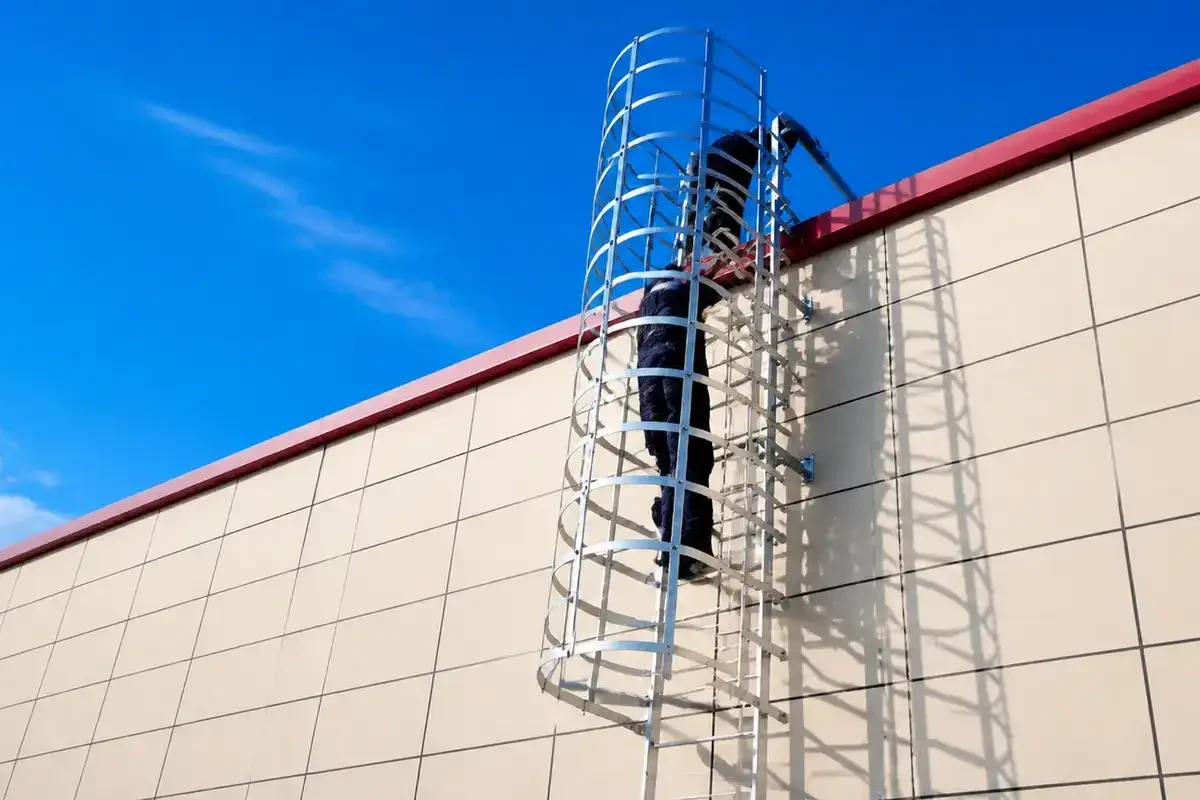
The choice between a fixed ladder (no cage) and a caged ladder (with hoop guard) is the first and most fundamental specification decision. The answer is primarily driven by regulatory requirements based on ladder height, but safety considerations, cost, and installation complexity also factor in. This article explains the differences and provides a clear decision framework.
The Fundamental Difference
| Feature | Fixed Ladder (FL Series) | Caged Ladder (CL/CT Series) |
|---|---|---|
| ——— | ————————- | ————————— |
| Fall protection | None — relies on climber’s three-point contact | Passive cage — restricts backward falls |
| Structure | Stiles + rungs + brackets | Stiles + rungs + brackets + cage hoops + vertical straps |
| Weight (6m) | ~70 kg | ~90 kg |
| Cost (HDG, per m) | $23 | $30 |
| Height range (standard) | 2-10m | 2-20m |
| Installation complexity | Lower | Higher (cage alignment, hoops) |
When a Cage Is Required by Regulation
| Jurisdiction | Cage Required Above | Standard |
|---|---|---|
| ————- | ——————- | ——— |
| United States | 24 ft (7.3m) | OSHA 1910.23 |
| European Union | 3m | EN ISO 14122-4 |
| Australia | 4m | AS 1657 |
| United Kingdom | 2.5m | BS 4211 |
| India | Per IS | IS |
Important OSHA note: For new US installations after November 19, 2018 and exceeding 24 ft, a ladder safety system or PFAS is required in addition to the cage. A cage alone is not sufficient.
The $7/Meter Question
The incremental cost of adding a cage to a fixed ladder is approximately $7/m ($23/m fixed vs $30/m caged for HDG). For a 6m ladder, the cage adds $42 to the total cost. When weighed against the safety benefit, this is one of the most cost-effective safety investments you can make.
Dengtai’s recommendation: Install a cage on any fixed ladder over 2.5m, regardless of regulatory requirement. The cage provides fall protection at a marginal cost increment and future-proofs the installation against potential regulatory changes.
When a Fixed Ladder Without Cage Is the Right Choice
- Short access (under 2m) — mezzanine step, equipment platform access
- Where cage would obstruct operations — loading dock, tight machinery spacing
- When the ladder is used for equipment access only, not personnel access
- Where local regulations do not require a cage and the project budget is extremely constrained
When a Caged Ladder Is the Right Choice
- Any ladder exceeding the regulatory trigger height
- Ladders used frequently by personnel (multiple times per shift)
- Outdoor installations where wind could affect climber stability
- Safety-conscious projects where the cage is specified as a design standard regardless of height
- US projects — even if under 24 ft, the cage provides value and future compliance flexibility
Can a Cage Be Added Later?
Yes, a cage can be retrofitted to an existing fixed ladder. The retrofit involves welding or bolting cage hoops and vertical straps to the existing ladder stiles and installing any necessary additional brackets. However:
- Retrofit cost (on-site labor + materials) typically exceeds the $7/m factory difference
- Welding on-site requires hot work permits, fire watch, and may not be permitted in operating facilities
- Factory-installed cages are more precisely aligned and structurally integrated
Verdict: It is more cost-effective to purchase a caged ladder initially than to retrofit later.
Bollard Protection for Exterior Ladders
If the fixed or caged ladder is installed at ground level in a loading dock, parking area, or vehicle zone, consider whether bollard protection is necessary. SS304 or HDG bollards (typically 150mm diameter, filled with concrete) should be installed 1m in front of the ladder to prevent vehicle impact. A ladder struck by a forklift can suffer structural damage that is not immediately visible — and that damage can lead to failure under load during the next climb.
Rung vs Tread Options for Inclined Access
Some installations require a ladder that is steeper than stairs but more comfortable than a vertical ladder. In these cases, consider specifying inclined stringers (typically 10-15 degrees off vertical) combined with flat-top rungs or grating treads. An inclined fixed ladder provides better foot support than a vertical ladder and is preferred for locations where climbers carry tools or maintenance equipment. Note that inclined ladders typically require a cage, regardless of height, because the climber’s center of gravity is farther from the ladder face.
Safety Gate Integration
All caged ladders should include a self-closing safety gate at the top landing. The gate must:
- Open away from the ladder opening (toward the landing)
- Self-close via spring or gravity mechanism
- Be operable with one hand by a climber transitioning from the ladder
- Have a minimum height of 1,100mm (42 in)
Dengtai safety gates are fabricated from the same material as the ladder (HDG or SS) and pre-drilled for bolt-on installation at the top landing.
Cage Entrance and Exit Configurations
The cage entrance at ground level must include a flare hoop (approximately 800-1,000mm diameter at the bottom, flaring outward to 1,200-1,400mm) to guide the climber into the enclosure. For side-exit configurations at intermediate landings, the cage must have an opening aligned with the landing gate, and the opening must be reinforced with additional vertical strapping to maintain structural integrity at the gap.
Frequently Asked Questions
1. Do I need a cage if my ladder is only 4 meters high?
Depends on the jurisdiction. Under EN ISO 14122-4 (EU), a cage is required above 3m — so yes, at 4m a cage is mandatory. Under AS 1657 (Australia), the trigger is 4m — at exactly 4m, a case could be made either way, but a cage is recommended. Under OSHA (US), the cage trigger is 24 ft (7.3m), so at 4m a cage is optional. Under BS 4211 (UK), the trigger is 2.5m, so a cage is required. Always check local regulations, but for any ladder over 3m, a cage is a prudent investment regardless of jurisdiction.
2. Is a caged ladder the same as a cat ladder?
Yes, in the UK, Ireland, Singapore, Malaysia, and Hong Kong, “cat ladder” is the standard term for what is called a “caged ladder” in North America, Europe, and Australia. The two terms describe the same product: a vertical fixed ladder with hoop guards. See our article on Cat Ladder vs Cage Ladder for the full terminology breakdown.
3. Can I buy a fixed ladder now and add the cage later?
Technically yes, but we don’t recommend it. On-site cage retrofit costs significantly more than the factory $7/m premium due to labor, hot work permits (if welding is required), and access equipment. Factory-installed cages are also more precisely aligned and structurally integrated. If there is any chance you might need a cage in the future, buy it installed from the factory.
The Bottom Line
If your ladder height exceeds 3m, you almost certainly need a cage — and even if it doesn’t, a cage adds meaningful safety at a marginal cost. Start with the caged option and eliminate it only if site conditions, budget, or operational constraints make a fixed ladder necessary.
View Caged Ladders → | View Fixed Ladders →
About the Author
Jouth Zhao is Senior Engineer at Dengtai Staircase Manufacturing Co., Ltd., specializing in fixed and caged ladder specification for OSHA, EN, AS, and BS compliant installations across 50+ countries.
Related Articles
- When Is a Cage Required on a Ladder?
- What Is a Caged Ladder? — Complete Design & Specification Guide
- Cat Ladder vs Cage Ladder — Terminology & Regional Differences
- Fixed Steel Ladders Product Page
>()。、(OSHA 24/EN 3/AS 4/BS 2.5)、($23/m vs $30/m)、。3,$7/。:、。