Author: Jouth Zhao, Senior Engineer, Dengtai Staircase Manufacturing Co., Ltd. | Last updated: May 27, 2026 | Reading time: 7 min
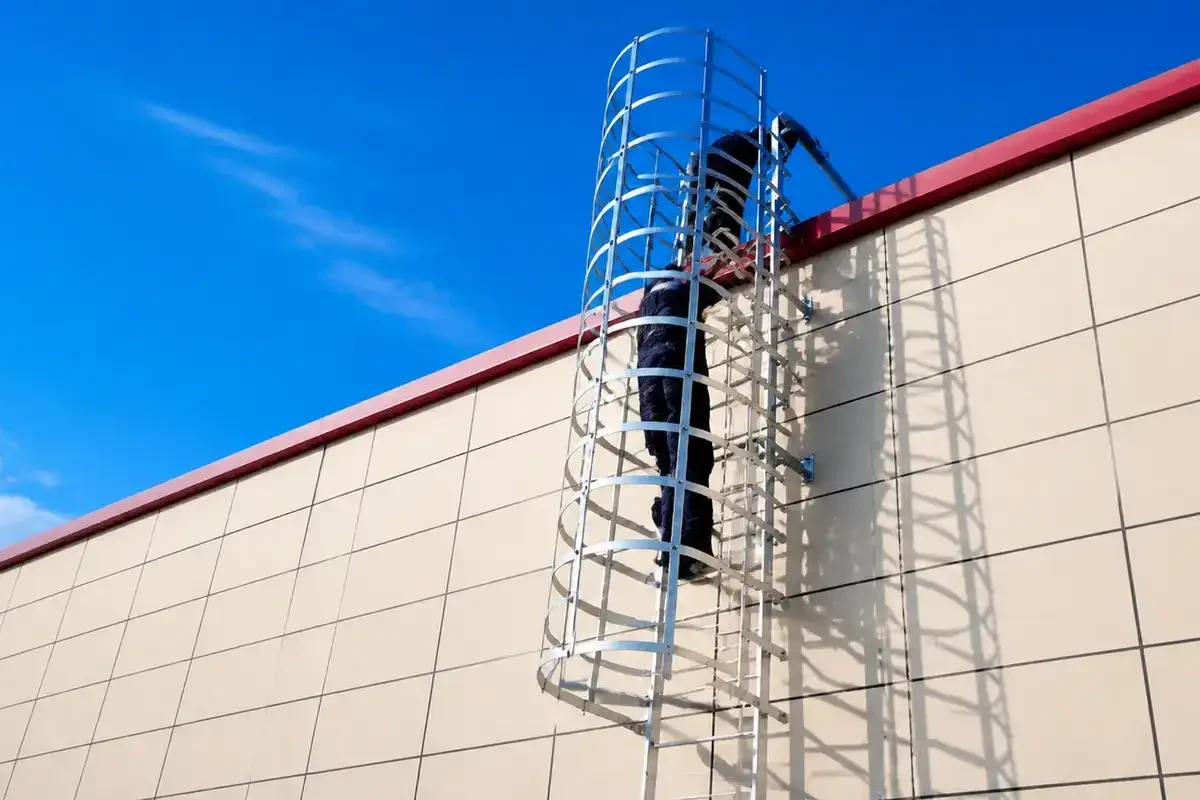
A caged ladder is a fixed vertical ladder surrounded by a safety cage — a series of circular steel hoops connected by vertical straps that create a protective enclosure around the climbing path. The cage serves as passive fall protection: if a climber loses grip or footing, the cage restricts backward movement and prevents a fall away from the ladder structure. Per OSHA 1910.23(d)(4), a cage (or alternative fall protection system) is required on any fixed ladder exceeding 24 feet (7.3m) in total height.
This article explains the purpose of the cage, when it is required, how it is designed, and the important regulatory change that affects all new caged ladder installations in the United States.
Definition: What Makes a Ladder “Caged”
The defining feature of a caged ladder is the hoop guard — a protective enclosure made of the following components:
| Component | Description | Typical Specification |
|---|---|---|
| ———– | ———— | ———————- |
| Hoops | Circular or U-shaped steel bars forming rings around the ladder | 800mm diameter at 300mm vertical spacing; minimum 5 hoops per cage |
| Vertical straps | Steel flat bars connecting the hoops vertically, equally spaced around the circumference | 5 straps equally spaced; typically 40mm × 5mm flat bar |
| Cage flare | The widened bottom section of the cage that guides the climber into the enclosure | Flared outward by 100-150mm at the bottom hoop |
| Top extension | The portion of the cage extending above the landing surface | 1,100mm (42 in) minimum per OSHA 1910.23(d)(4)(iv) |
| Bottom offset | The distance from ground level to where the cage begins | 2,100-2,400mm (7-8 ft) per OSHA 1910.23(d)(4)(ii) |
The Purpose of a Ladder Safety Cage
The cage serves one primary function: preventing a backward fall from the ladder.
It is important to understand what a cage does not do:
- A cage does not arrest a fall in the way that a harness and lanyard system does. If a climber loses consciousness or becomes incapacitated, the cage provides limited protection.
- A cage does not provide fall protection during the transition from ladder to landing — this is why guardrails at the landing level are required.
- A cage does not eliminate the need for proper climbing technique — three points of contact remain essential.
This limitation is precisely why OSHA’s 2018 update to Walking-Working Surfaces (1910.27) now requires a personal fall arrest system or ladder safety system — not just a cage — on new fixed ladders exceeding 24 feet.
When Is a Cage Required?
The cage requirement depends on the applicable standard and the total ladder height.
| Jurisdiction | Standard | Cage Required Above | Notes |
|---|---|---|---|
| ————- | ———- | ——————- | ——- |
| United States | OSHA 1910.23(d)(4) | 24 ft (7.3m) | For new ladders (post-2018): cage alone is NOT sufficient for >24 ft; PFAS or ladder safety system also required |
| European Union | EN ISO 14122-4 | 3m (9.8 ft) | Cage standard requires CE/UKCA compliance pathway |
| Australia | AS 1657 | 4m (13.1 ft) | Cage required; landing platforms at 6m maximum intervals |
| United Kingdom | BS 4211 | 2.5m (8.2 ft) | Cage required per the Work at Height Regulations risk assessment |
Cage below the requirement threshold: Installing a cage on a ladder shorter than the regulatory threshold is permitted and is common practice for safety-conscious projects. The incremental cost of adding a cage to a fixed ladder is approximately $7/m (difference between CL-HDG-STD at $30/m and FL-HDG-STD at $23/m).
OSHA 2036: The Phase-Out of Cage-Only Systems
In November 2016, OSHA published the final rule updating 29 CFR 1910 Subpart D (Walking-Working Surfaces). The key change affecting caged ladders:
- Before November 19, 2018: Cages and wells were acceptable as the sole fall protection system on fixed ladders over 24 feet.
- After November 19, 2018 (new installations): All new fixed ladders over 24 feet must be equipped with a ladder safety system or personal fall arrest system (PFAS). A cage alone no longer satisfies the regulatory requirement.
- November 19, 2036 (deadline): All existing fixed ladders over 24 feet must be retrofitted with a ladder safety system or PFAS, regardless of when they were installed.
What this means today (2026): If you are installing a new caged ladder over 24 feet in a US workplace, you must also install a ladder safety system (vertical lifeline with a cable sleeve) or ensure that users wear a harness and lanyard connected to an approved anchor. Dengtai can supply the ladder with an integrated vertical lifeline system — specify this requirement at the time of inquiry.
For the complete timeline, requirements, and compliance strategies: Are Cage Ladders Being Phased Out?
Cage Design Standards: Key Dimensions
| Parameter | OSHA 1910.23 | EN ISO 14122-4 | Dengtai Standard |
|---|---|---|---|
| ———– | ————- | —————- | —————– |
| Hoop inside diameter | 27-30 in (686-762mm) | Specified per design calculation | 800mm |
| Hoop vertical spacing | Not specified (determined by strap configuration) | 300mm maximum | 300mm |
| Number of vertical straps | 5 minimum, equally spaced | 5 minimum | 5 |
| Cage bottom offset | 7-8 ft (2.1-2.4m) from base | As specified | 2.2m |
| Cage top extension | 42 in (1,100mm) minimum | 1,100mm minimum | 1,100mm |
| Clearance inside cage | Not specified directly | 380mm from ladder centerline | 380mm |
Caged Ladder Materials and Application Suitability
| Material | Best For | Typical Lifespan | Cost Reference |
|---|---|---|---|
| ———- | ——— | —————– | ————— |
| HDG Q235B | General industrial, commercial, outdoor non-coastal | 15-25 years | $30/m |
| HDG Q345B (Heavy-Duty) | High load, wide spans, heavy industrial | 20-30 years | Custom quote |
| SS304 (EN 1.4301) | Food processing, pharmaceutical, mild coastal | 30+ years | $77/m |
| SS316 (EN 1.4401) | Chemical plants, offshore, heavy coastal, water treatment | 50+ years | $115/m |
For material selection guidance: Steel Ladder Material Selection Guide →
Frequently Asked Questions
What is the difference between a caged ladder and a fixed ladder?
A caged ladder IS a fixed ladder — with a safety cage added. A fixed ladder without a cage is simply called a “fixed ladder.” The cage transforms passive fall protection from none to a hoop guard enclosure. The core ladder structure (stiles, rungs, brackets) is the same in both products.
Does a caged ladder meet OSHA fall protection requirements?
For new installations after November 19, 2018: a cage alone does NOT meet OSHA requirements for ladders over 24 feet. A ladder safety system or personal fall arrest system is also required. For existing installations (pre-November 2018): the cage remains acceptable until the November 2036 retrofit deadline. For ladders under 24 feet: a cage is not required but meets or exceeds the requirement.
How high can a caged ladder go?
With multi-section configurations (CL-HDG-MULTI), Dengtai caged ladders can reach 20m (66 ft). Each section is 3-6m, with flanged joints between sections and intermediate landing platforms at 6-9m vertical intervals. Beyond 20m, an engineered multi-section solution with additional structural support is required.
How wide is the cage on a standard caged ladder?
Dengtai’s standard cage inside diameter is 800mm (31.5 in). This provides approximately 380mm (15 in) of clearance between the ladder centerline and the cage hoops — sufficient for a climber wearing standard work clothing and a tool belt. For climbers wearing bulky PPE (chemical suits, cold-weather gear), a wider cage can be specified as a custom option.
Can a caged ladder be retrofitted with a ladder safety system?
Yes. Most existing caged ladders can be retrofitted with a vertical lifeline system without removing the cage. The lifeline cable or rail is mounted inside the cage, typically attached to the rungs or stiles. Dengtai can supply retrofit kits for our own ladders and can advise on retrofitting third-party installations. Contact our engineering team with ladder photos and measurements for a feasibility assessment.
How much does a caged ladder weigh?
A 6m CL-HDG-STD weighs approximately 85-95 kg (187-209 lbs). Weight varies by material: SS304 is slightly heavier due to density (8.0 g/cm³ vs 7.85 g/cm³ for carbon steel). The weight is relevant for shipping cost calculation and for determining whether installation requires mechanical lifting equipment.
How do I determine if I need a caged ladder or a fixed ladder without cage?
Measure the total vertical height from the base mounting point to the top landing surface. If it exceeds your jurisdiction’s cage-requirement threshold (24 ft OSHA / 3m EN / 2.5m BS / 4m AS), you need at minimum a caged ladder — and for new US installations exceeding 24 ft, you also need a ladder safety system. When in doubt, adding a cage adds $7/m and provides protection regardless of the regulatory minimum.
Need a Caged Ladder for Your Project?
OSHA/EN/AS compliant. HDG, SS304, SS316. Factory-direct from $30/m.
Email: sales@dtsteelladder.com
WhatsApp: +86 155 1187 9488
Request a Quote → | View Caged Ladders →
About the Author
Jouth Zhao is Senior Engineer at Dengtai Staircase Manufacturing Co., Ltd. He has designed and overseen production of caged ladders for 500+ industrial projects worldwide, with expertise in cage design per OSHA, EN, AS, and BS standards.
Related Resources
- Caged Ladders Product Page →
- OSHA 1910.23 Compliance Guide →
- Are Cage Ladders Being Phased Out? →
- Ladder Safety Cage Guide →
- Cat Ladder vs Cage Ladder →
>?:++++,。(OSHA 24/EN 3/AS 4/BS 2.5)、(//)、。