Author: Jouth Zhao, Senior Engineer, Dengtai Staircase Manufacturing Co., Ltd. | Last updated: May 27, 2026 | Reading time: 7 min
The short answer: cages are not being banned, but they are no longer sufficient as the sole fall protection system on new tall fixed ladders in the United States. OSHA’s 2018 Walking-Working Surfaces update (1910.27) requires that all new fixed ladders exceeding 24 feet must use a ladder safety system or personal fall arrest system (PFAS) — not just a cage. Existing caged ladder installations have until November 19, 2036, to be retrofitted. This article explains the regulation, the timeline, and what facility owners need to do to prepare.
What OSHA Actually Changed
The regulation in question is 29 CFR 1910.27 (Scaffolds and rope descent systems) and 1910.23 (Ladders), updated as part of OSHA’s final rule on Walking-Working Surfaces published November 18, 2016, effective January 17, 2017.
Before the Update
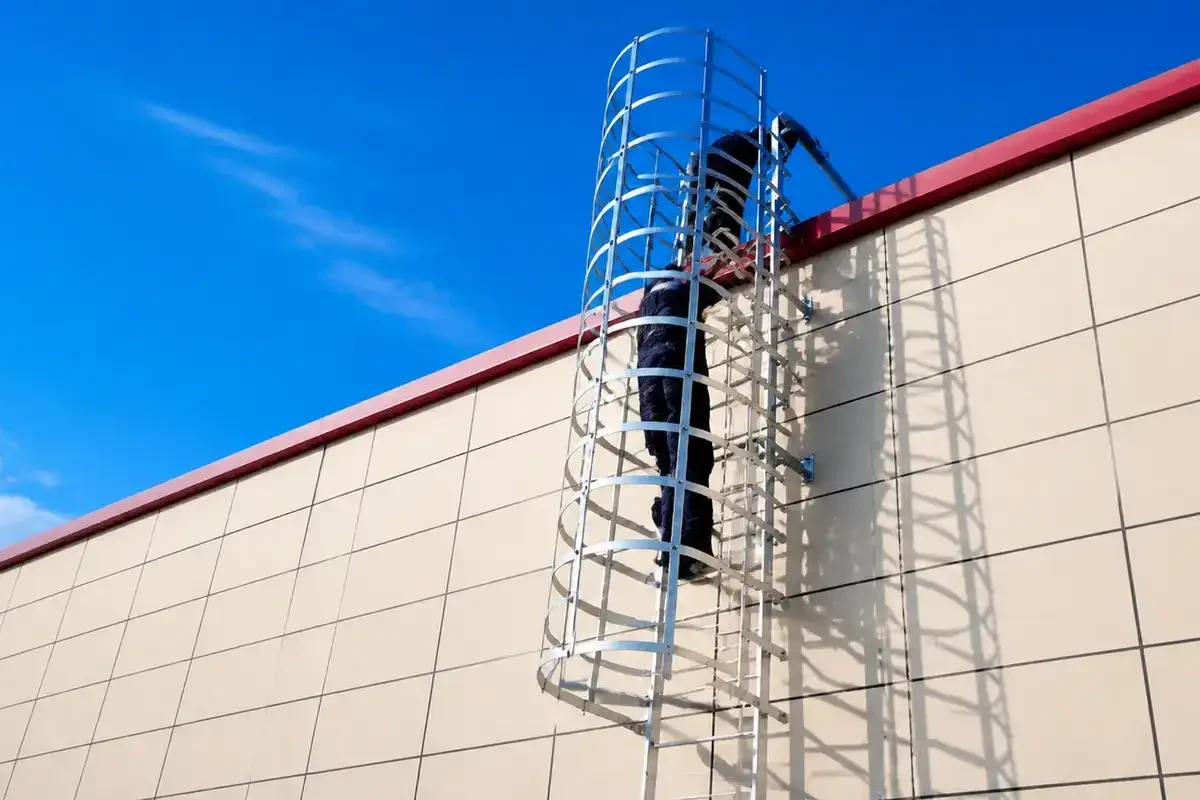
Cages and wells were the standard fall protection method for fixed ladders. OSHA 1910.27 previously treated cages as an acceptable primary fall protection system with no expiration date.
After the Update
OSHA formally recognized that cages do not reliably arrest a fall:
- A climber who loses consciousness or becomes incapacitated may slide through the cage without being stopped.
- Cages provide no protection in the transition zone at the top of the ladder.
- Ladder safety systems (vertical lifelines with cable sleeves) and PFAS (harness + lanyard + anchor) are more effective at preventing serious injury or death.
The Key Text (29 CFR 1910.28(b)(9)(i))
> “The employer must ensure that each new fixed ladder installed on or after November 19, 2018, that extends more than 24 feet (7.3m) above a lower level is equipped with a ladder safety system or personal fall arrest system.”
Cages and wells are not considered ladder safety systems under the new rule.
The OSHA 2036 Timeline
| Date | Requirement |
|---|---|
| —— | ———— |
| January 17, 2017 | OSHA Walking-Working Surfaces final rule becomes effective |
| November 19, 2018 | All NEW fixed ladders over 24 ft must have ladder safety system or PFAS (cage alone not sufficient) |
| November 19, 2036 | Deadline for retrofitting ALL existing fixed ladders over 24 ft — cages on pre-2018 ladders must be supplemented with ladder safety system or PFAS |
What this means for your facility in 2026:
- If you have ladders installed before November 19, 2018: You have 10 years (until 2036) to retrofit. Start planning now — 10 years may seem like a long time, but capital budgeting, contractor scheduling, and phased implementation across a large facility take years.
- If you are installing new ladders now: You must include a ladder safety system or PFAS — the 2018 deadline has already passed.
- If you order new ladders for replacement of existing installations: The new ladder is considered a new installation — the 2018 requirements apply. You cannot replace a pre-2018 caged ladder with a new cage-only ladder and claim it is grandfathered.
Ladder Safety Systems vs Personal Fall Arrest Systems
Ladder Safety System
A permanent vertical lifeline (cable or rigid rail) attached to the ladder structure. The climber wears a full-body harness connected to a sleeve or shuttle that travels along the lifeline. The sleeve locks onto the cable if the climber falls.
Advantages:
- No user action required — the sleeve automatically locks during a fall
- Permanent installation — no equipment to don, doff, or store
- Compatible with existing caged ladders — can be retrofitted inside the cage
Personal Fall Arrest System (PFAS)
A full-body harness worn by the climber, connected by a lanyard to an approved anchorage point. Used primarily during the transition at the top of the ladder or when a ladder safety system is not practical.
Advantages:
- Provides protection during ladder-to-landing transitions
- Also serves as fall protection for rooftop or platform work
- No permanent installation required
Typical configuration for new caged ladder installations: A ladder safety system (vertical lifeline) is the primary protection during the climb. A PFAS provides supplemental protection during the transition at the top landing.
Does This Apply Outside the United States?
No. OSHA regulations apply only to workplaces under OSHA jurisdiction (US states and territories). Other jurisdictions have their own standards:
| Jurisdiction | Cage-Only Still Accepted for New Ladders? | Notes |
|---|---|---|
| ————- | —————————————- | ——- |
| European Union (EN ISO 14122-4) | Yes | Cages remain the primary standard. Ladder safety systems optional. |
| United Kingdom (BS 4211) | Yes | Cages remain acceptable. WAHR risk assessment may recommend additional systems. |
| Australia (AS 1657) | Yes | Cages remain standard for ladders exceeding 4m height. |
| Canada (CSA Z259) | Varies by province | Some provinces follow OSHA-style requirements; check provincial OHS regulations. |
| Middle East, Southeast Asia (OSHA/EN-referenced) | Depends on referenced standard | Projects referencing OSHA may require US-compliant systems; projects referencing EN accept cages. |
For international projects, confirm the applicable standard with the project engineer or local authority.
Compliance Strategy for Facility Managers
If you manage a facility with existing caged ladders, follow this phased approach:
Phase 1 (2026-2028): Inventory and Assessment
- [ ] Catalog every fixed ladder in your facility (height, installation date, condition, current fall protection type)
- [ ] Identify which ladders exceed 24 feet
- [ ] Assess the structural condition of each ladder — a ladder that needs replacement anyway should be replaced with a new ladder + integrated safety system
Phase 2 (2028-2032): Budget and Prioritize
- [ ] Obtain retrofit quotations for high-priority ladders (heavily used, poor condition, high consequence of fall)
- [ ] Include retrofit costs in capital expenditure planning
- [ ] Evaluate replacement vs retrofit economics — replacing a 30-year-old ladder with a new ladder + integrated system may cost less than retrofitting
Phase 3 (2032-2036): Execute Retrofits
- [ ] Schedule retrofits during planned maintenance shutdowns to minimize operational disruption
- [ ] Maintain documentation of all retrofits (date, system type, installer, certification)
- [ ] Train workers on use of the new ladder safety system
Download OSHA 2036 Readiness Checklist (PDF) →
Dengtai’s Position
Dengtai manufactures caged ladders that comply with OSHA 1910.23 dimensional and load requirements. For new US installations exceeding 24 feet, we offer:
1. Caged ladder + integrated vertical lifeline mounting provisions — The ladder is manufactured with pre-drilled mounting points for a ladder safety system cable or rail, allowing your local safety equipment provider to install the lifeline without modifications to the ladder.
2. Caged ladder only — For projects outside the US where cages remain the accepted primary fall protection, or for ladders under 24 feet where cages are optional but not required.
3. Consultation on retrofit feasibility — Send photos and measurements of your existing caged ladders for an engineering assessment of retrofit compatibility.
Specify your requirements at the time of inquiry so we can provide the appropriate configuration and compliance documentation.
Frequently Asked Questions
Will my existing caged ladder pass an OSHA inspection in 2026?
Yes, if it was installed before November 19, 2018 and is in good condition. OSHA allows continued use of existing cage-only ladders until the November 2036 retrofit deadline. Ensure you have installation records (or a reasonable estimate of the installation date) and documented annual inspections.
Can I install a new cage-only ladder in 2026 for a 30-foot installation?
No. Any new fixed ladder installed after November 19, 2018 that exceeds 24 feet must have a ladder safety system or PFAS — a cage alone does not satisfy the requirement. If you install a cage-only ladder now, you are in violation of 1910.28(b)(9)(i).
Does this apply to ladders under 24 feet?
No. OSHA 1910.28(b)(9)(i) applies specifically to ladders “that extend more than 24 feet (7.3m) above a lower level.” Ladders under 24 feet may use a cage, no fall protection at all, or a ladder safety system — it is the employer’s choice based on the hazard assessment.
What if I am replacing a damaged section of an existing caged ladder?
Replacement of a section (rungs, stile segment, cage hoops) on a pre-2018 ladder is considered maintenance, not a new installation, as long as the overall ladder structure remains the original pre-2018 installation. If you are replacing the entire ladder, the new ladder is subject to the post-2018 requirements.
How much does it cost to retrofit a ladder safety system?
Costs vary by ladder height, system type (cable vs rigid rail), and installer. As a rough estimate: a vertical cable lifeline system for a 30-foot ladder ranges from $1,500 to $3,500 installed (US domestic pricing). Multiple ladders at the same facility may benefit from volume pricing. Add this to your Phase 2 budgeting.
What happens if I do nothing and wait until 2036?
On November 19, 2036, all cage-only fixed ladders over 24 feet become non-compliant. OSHA may cite and fine the employer. More importantly, if a fall incident occurs on a non-compliant ladder, the legal and financial exposure is significant. The 10-year window is intended to allow phased, budgeted compliance — not a reason to defer action.
Take Action on OSHA 2036 Compliance
Need a new caged ladder with integrated safety system provisions, or a retrofit assessment for existing ladders?
Email: sales@dtsteelladder.com
WhatsApp: +86 155 1187 9488
About the Author
Jouth Zhao is Senior Engineer at Dengtai Staircase Manufacturing Co., Ltd. He monitors OSHA, EN, AS, and BS regulatory developments and ensures Dengtai product lines maintain compliance with evolving fall protection requirements.
Related Resources
- Caged Ladders Product Page →
- OSHA 1910.23 Complete Guide →
- What Is a Caged Ladder? →
- Ladder Safety Cage Guide →
- Fixed Ladder Requirements OSHA →
>?OSHA 2036:20181124,203611。()、(/PFAS)。