Author: Jouth Zhao, Senior Engineer, Dengtai Staircase Manufacturing Co., Ltd. | Last updated: May 27, 2026 | Reading time: 6 min
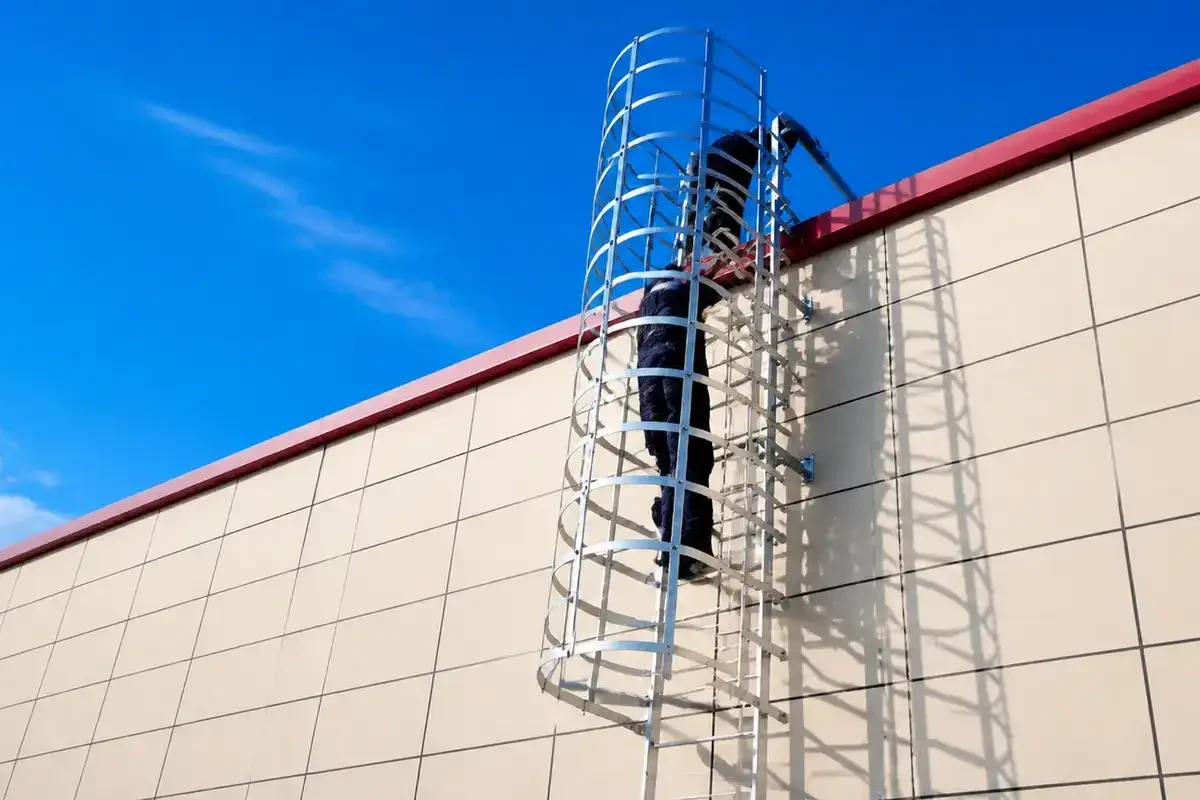
A ladder safety cage — also called a hoop guard or cage guard — is the protective enclosure of circular steel hoops surrounding a fixed vertical ladder. Its purpose is to prevent a climber from falling backward if they lose grip or footing. This guide covers cage design requirements across all major standards, when a cage is required versus when a ladder safety system is required, and how to specify the right cage for your project.
What a Safety Cage Does (and Does Not Do)
What a cage does:
- Restricts backward movement if the climber slips
- Provides a physical and psychological sense of enclosure during the climb
- May guide a falling climber back toward the rungs in a minor slip
What a cage does NOT do:
- Does not positively arrest a fall — a climber who loses consciousness may slide through the cage
- Does not protect during the transition from ladder to landing
- Does not provide fall protection equivalent to a harness and lanyard system
- Does not meet OSHA’s post-2018 requirement for new ladders over 24 feet
This is precisely why OSHA now requires a ladder safety system or PFAS (in addition to or instead of a cage) for new tall ladder installations. A cage is supplemental protection — it is not a complete fall arrest solution.
Cage Design by Standard
| Parameter | OSHA 1910.23 | EN ISO 14122-4 | BS 4211 | AS 1657 | Dengtai Standard |
|---|---|---|---|---|---|
| ———– | ————- | —————- | ——— | ——— | —————– |
| Hoop inside diameter | 27-30 in (686-762mm) | 650-800mm from ladder CL | Per standard | Per standard | 800mm |
| Hoop vertical spacing | Per design | ≤300mm | ≤300mm | Per standard | 300mm |
| Vertical straps | 5 min, equally spaced | 5 min, equally spaced | Per standard | Per standard | 5 |
| Bottom offset from base | 7-8 ft (2.1-2.4m) | 2,200-3,000mm | Per standard | Per standard | 2,200mm |
| Top extension above landing | 42 in (1,100mm) | ≥1,100mm | ≥1,100mm | ≥1,000mm | 1,100mm |
| Flare at bottom | Not specified | Required | Per standard | Per standard | 100-150mm flare |
When Is a Cage Required?
| Standard | Cage Required If… | Notes |
|---|---|---|
| ———- | ——————- | ——- |
| OSHA 1910.23 | Ladder >24 ft (7.3m) | For new installations, cage alone is NOT sufficient — ladder safety system or PFAS also required |
| EN ISO 14122-4 | Ladder >3m | Cage is the primary fall protection; ladder safety system optional |
| BS 4211 | Ladder >2.5m | Cage required per UK standard |
| AS 1657 | Ladder >4m | Cage required; landing platforms at 6m max intervals |
Practical recommendation: If your ladder is short enough to not require a cage under your standard, consider installing one anyway. The incremental cost is approximately $7/m (difference between caged and uncaged ladder pricing). The added safety margin and reduced liability risk justify the small premium.
Cage Materials
A ladder safety cage is fabricated from the same material as the ladder stiles and rungs, ensuring uniform corrosion protection and thermal expansion characteristics.
| Material | Cage Finish | Typical Lifespan | Cost Reference (caged ladder per meter) |
|---|---|---|---|
| ———- | ———— | —————– | ————————————— |
| Q235B HDG | Hot-dip galvanized (≥80μm) | 15-25 years | $30/m (CL-HDG-STD) |
| SS304 | 240# brushed + passivation | 30+ years | $77/m (CL-SS304-STD) |
| SS316 | Acid pickled + passivated | 50+ years | $115/m (CL-SS316-STD) |
The cage hoops are typically fabricated from the same diameter round bar or flat bar as the ladder rungs (20mm round bar standard), with vertical straps of 40mm × 5mm flat bar. All welded connections are inspected to ISO 5817 Quality Level C.
Cage Retrofit and Replacement
Can a cage be added to an existing fixed ladder without a cage?
Yes, in most cases. A cage retrofit kit includes hoops, vertical straps, and mounting brackets that bolt to the existing ladder stiles without requiring structural modification to the ladder. The wall brackets are not affected. Contact our engineering team with the existing ladder’s stile dimensions and spacing to verify compatibility.
Can a damaged cage section be replaced?
Yes. Individual hoops or vertical strap sections can be replaced by cutting out the damaged component and bolting or welding in a replacement. For galvanized ladders, welded repairs must be touched up with zinc-rich paint (minimum 93% zinc in dry film) to maintain corrosion protection at the repair site.
Can a vertical lifeline system be retrofitted inside an existing cage?
Yes. A vertical cable lifeline can be mounted inside the cage enclosure, typically attached to the ladder rungs or stiles. The cage hoops do not interfere with the lifeline if the mounting brackets are correctly positioned. This is the standard method for bringing pre-2018 caged ladders into compliance with OSHA’s 2036 retrofit deadline.
Common Cage Design Errors to Avoid
| Error | Consequence | Prevention |
|---|---|---|
| ——- | ———— | ———– |
| Cage hoops spaced >300mm apart | Gaps large enough for a person to fall through | Verify 300mm uniform spacing during production and after installation |
| Cage too narrow (<650mm from ladder CL) | Climber’s shoulders or tool belt hits cage during climb | Specify 800mm diameter; verify order specification |
| Bottom flare omitted or reversed | Difficult entry into cage from the base | Verify flare is wider at the bottom (100-150mm flared) |
| Cage not extending 1,100mm above landing | No protection during the critical transition | Include 1,100mm extension in order specification |
| Galvanizing damage during installation not repaired | Corrosion at damaged points within 1-2 years | Keep zinc-rich touch-up spray on-site during installation |
Frequently Asked Questions
Does the cage affect the climbing experience?
The cage enclosure is designed to accommodate normal climbing movement with standard work clothing. The 380mm clearance from the ladder centerline to the hoop inside surface provides sufficient shoulder and hip clearance for most adults. Climbers wearing bulky PPE (chemical suits, cold-weather gear, SCBA equipment) should notify us during the specification stage — a wider cage may be needed.
Is a cage required on indoor ladders?
The cage requirement under all standards (OSHA, EN, BS, AS) applies equally to indoor and outdoor installations. The determining factor is ladder height, not indoor/outdoor location. However, indoor ladders often use only a cage (no lifeline) even for tall installations because indoor environments fall under different OSHA enforcement than outdoor industrial sites.
Does a cage interfere with roof hatch access?
A ladder with a cage can be configured for roof hatch access. The cage terminates approximately 2,100mm above the hatch level, and the ladder continues (without cage) through the hatch opening. The transition requires a grab bar extension. Specify “roof hatch application” on your inquiry for the correct configuration.
How do I specify cage requirements in a purchase order?
Include: “Caged ladder with safety cage per [OSHA 1910.23 / EN ISO 14122-4 / BS 4211 / AS 1657]. Hoop inside diameter 800mm. Hoop vertical spacing 300mm. Five vertical straps equally spaced. Bottom flare 100-150mm. Cage to extend 1,100mm above top landing. Material: [HDG / SS304 / SS316].”
Need a Caged Ladder?
OSHA/EN/BS/AS compliant cage design. HDG, SS304, SS316. Factory-direct from $30/m.
Email: sales@dtsteelladder.com
WhatsApp: +86 155 1187 9488
FAQ
Q: When is a safety cage required on a ladder?
Requirements vary by standard: OSHA requires a cage or ladder safety system on fixed ladders above 24 feet (7.3m). EN ISO 14122-4 requires fall protection (cage or other) on ladders above 3m where risk assessment indicates. AS 1657 requires cages above 6m. Dengtai offers cages as an option on all ladder models from 2m height.
Q: Can I add a cage to an existing uncaged ladder?
In most cases, yes. Retrofitting a cage requires: (1) confirming the existing ladder structure can support the additional weight and wind load of the cage, (2) verifying the existing bracket spacing is compatible with cage hoop positions, (3) checking that the cage does not interfere with surrounding equipment or walkways. Dengtai can provide a retrofit cage kit with engineering guidance.
Request a Quote → | View Caged Ladders →
About the Author
Jouth Zhao is Senior Engineer at Dengtai Staircase Manufacturing Co., Ltd. He designs and oversees production of safety cages for caged ladders supplied to 50+ countries.
Related Resources
- What Is a Caged Ladder? →
- Are Cage Ladders Being Phased Out? →
- Caged Ladders Product Page →
- OSHA 1910.23 Compliance Guide →
>(800mm)、(300mm)、(1,200-1,400mm)、(4-6)。OSHA/EN/AS/BS、(HDG/SS)、(//)。