Author: Jouth Zhao, Senior Engineer, Dengtai Staircase Manufacturing Co., Ltd. | Last updated: May 27, 2026 | Reading time: 5 min
Industrial facilities use multiple ladder types, each designed for a specific access scenario. Understanding the differences helps facility managers specify the right ladder for each location, avoiding both under-specification (safety risk) and over-specification (unnecessary cost). This guide covers the six main types of industrial ladders and their appropriate applications.
1. Fixed Ladder (No Cage)
A permanently attached vertical ladder without fall protection. The simplest and least expensive type.
Applications: Short equipment platforms (<3m), mezzanine access below cage trigger height, occasional maintenance access.
Cost: From $23/m (HDG Q235B)
Dengtai product: FL Series
2. Caged Ladder (Cat Ladder in UK)
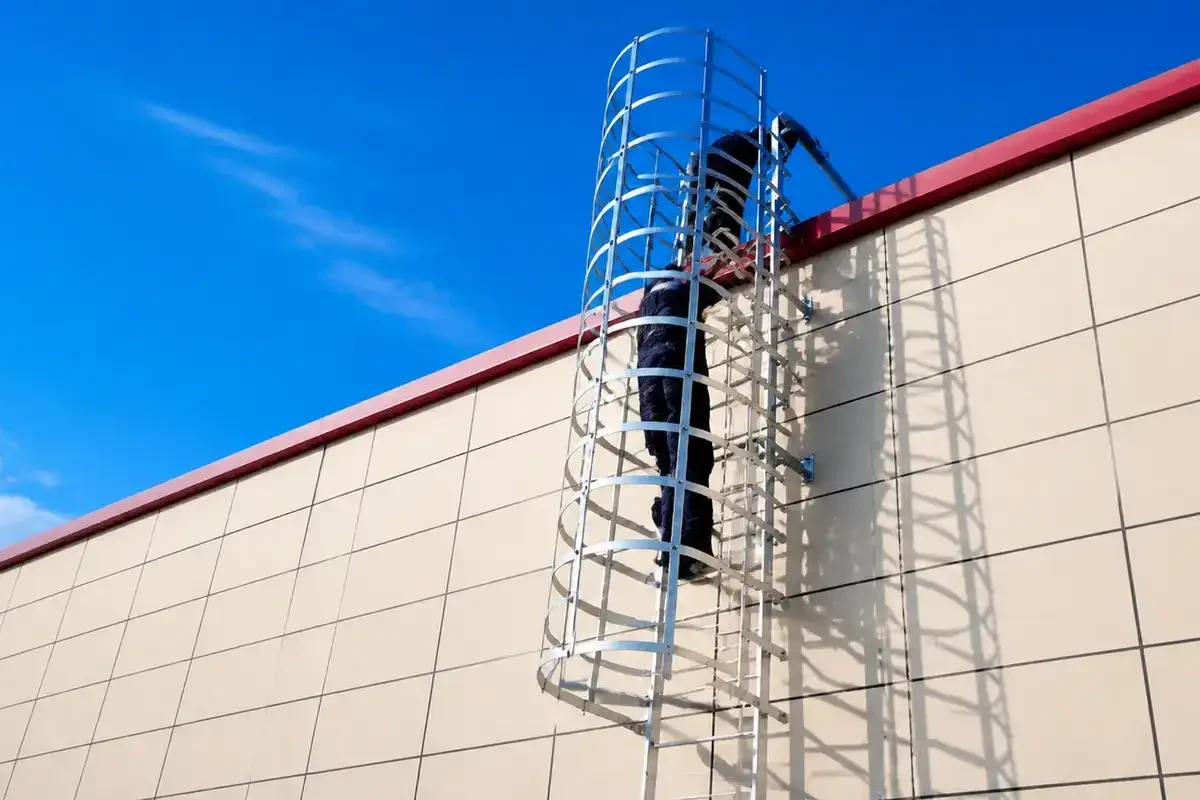
A fixed ladder with a surrounding hoop guard cage for passive fall protection.
Applications: Any ladder exceeding regulatory cage trigger height (24 ft OSHA, 3m EN, 4m AS, 2.5m BS). Tall structures, roof access, tank access, industrial platforms.
Cost: From $30/m (HDG Q235B)
Dengtai product: CL Series / CT Series (UK markets)
3. Heavy-Duty Ladder
A fixed or caged ladder with higher load capacity (450 lbs vs 300 lbs standard), wider stiles (700mm vs 600mm), and enhanced HDG coating (≥100μm vs ≥80μm).
Applications: Overhead crane access, steel mills, foundries, mining, heavy equipment platforms where climbers carry tools.
Cost: Custom quote
Dengtai product: FL-HDG-HD / CL-HDG-HD
4. Ship Ladder (Alternating Tread)
A steep stair-like access device with alternating treads at 50-70 degrees, more comfortable than a vertical ladder for frequent use. Not a true ladder but fills the gap between ladders and stairs.
Applications: Mezzanine access used multiple times per shift, equipment platforms accessed with tools, production line access.
Cost: Higher than fixed ladder due to tread complexity.
Note: Dengtai manufactures fixed vertical ladders. Ship ladders are a separate product category.
5. Retractable / Disappearing Ladder
A ladder that extends when needed and retracts into a compact stored position. The lower section is hinged or slides vertically.
Applications: Where a permanently extended ladder would obstruct operations, where security/access control is required at the ground level.
Cost: Higher than fixed ladder due to mechanism complexity.
Dengtai product: Available as a custom option on request.
6. Custom-Engineered Ladder
A ladder designed and manufactured to non-standard dimensions, materials, or configurations.
Applications: Non-standard heights (>20m), widths outside standard range, specialty materials (duplex stainless, Hastelloy), integration with existing structures, operator-specific technical standards.
Cost: Project-quoted; typically 40-80% premium over standard.
Dengtai product: CS-ENG
Which Ladder for Which Location?
| Location | Recommended Ladder | Reason |
|---|---|---|
| ——— | ——————- | ——– |
| Equipment platform, 2m | Fixed Ladder (FL-HDG-STD) | Below cage trigger; short access |
| Roof access, 8m | Caged Ladder (CL-HDG-STD) | Exceeds 3m trigger; outdoor |
| Overhead crane, 12m | Heavy-Duty Caged (CL-HDG-HD) | Frequent use, tools carried |
| Food plant mezzanine, 4m | Caged SS304 (CL-SS304-STD) | Hygienic environment; washdown |
| Chemical plant tower, 20m | Multi-section SS316 (CL-SS316-STD) | Chemical exposure; tall |
| Unique mounting requirement | Custom Engineering (CS-ENG) | Non-standard |
Ladder Type vs Access Frequency
The choice of ladder type should also consider how often the ladder is used:
| Access Frequency | Recommended Type | Reason |
|---|---|---|
| —————– | —————– | ——– |
| Emergency only (<1x/month) | Fixed Ladder FL Series | Minimal use; no cage needed below trigger height |
| Occasional maintenance (1-4x/month) | Caged Ladder CL Series | Added safety for infrequent but regular use |
| Daily use (1x/shift) | Caged Ladder with ship-ladder-style treads if inclined | More comfortable for frequent climbers |
| Multiple times per shift | Ship Ladder or stairs | Vertical ladders are not designed for high-frequency personnel traffic |
Roof Access vs Internal Access Ladder Types
Roof access ladders and internal equipment access ladders may look similar but have different requirements:
| Requirement | Roof Access Ladder | Internal Equipment Access |
|---|---|---|
| ———— | ——————- | ————————– |
| Weather exposure | Yes — requires HDG or SS | No — HDG is sufficient |
| Cage requirement | Almost always (height > 2.5-3m typical) | Only if height exceeds trigger |
| Access control | Lockable base gate or anti-climb shield | Often none required |
| Top landing | Parapet transition or roof hatch interface | Platform or mezzanine |
| Wind loading | Must be checked for buildings >20 stories | Not applicable |
Frequently Asked Questions
1. What is the difference between a ship ladder and a vertical fixed ladder?
A ship ladder has alternating treads at a 50-70 degree angle, providing a stair-like climbing experience. A vertical fixed ladder has rungs at 90 degrees and requires three-point contact climbing. Ship ladders are more comfortable for frequent use and allow the climber to carry small tools, but they require significantly more floor space (the footprint extends farther from the wall). Ship ladders are typically used for mezzanine access in production environments; vertical fixed ladders are used for equipment platforms, roof access, and tank access where space is constrained.
2. Can I use a retractable ladder for daily access?
Retractable ladders are primarily designed for security-controlled or obstruction-avoidance installations. While they can be used daily, the mechanism (hinge, slide, or counterweight) introduces a wear component that fixed ladders do not have. For daily use by multiple personnel, a fixed caged ladder is more reliable and requires no deployment action before climbing.
3. Do I need a heavy-duty ladder just because my workers carry tools?
Not necessarily. Standard Dengtai ladders are rated for 300 lbs (136 kg) — the combined weight of a climber plus clothing, tools, and equipment. Heavy-duty models (450 lbs / 204 kg) are for applications where the climber carries heavy tool bags, welding equipment, or spare parts exceeding 50 kg. If your workers typically carry a wrench and a radio, the standard 300 lb rating is sufficient.
Material and Finish Decisions
Once the ladder type is selected, choose the material:
- HDG Q235B: General industrial ($23-30/m)
- SS304: Food, pharmaceutical, visible areas ($62-77/m)
- SS316: Coastal, chemical, offshore ($73-115/m)
Author: Jouth Zhao, Senior Engineer
View All Ladder Types → | Selection Guide →
About the Author
Jouth Zhao is Senior Engineer at Dengtai Staircase Manufacturing Co., Ltd., with expertise across all six industrial ladder types spanning 500+ projects in 50+ countries. He regularly advises facility managers and procurement teams on ladder type selection for complex industrial access requirements.
Related Articles
- Fixed Ladder vs Caged Ladder — Which Type Does Your Project Need?
- What Is a Caged Ladder? — Complete Design & Specification Guide
- Fixed Ladder vs Stairs — Access Type Decision Framework
- All Products — View Complete Range
>()、()、、()、、。、、,(////)。:HDG、SS304、SS316。