[breadcrumb: Home > Products > Compare > Fixed vs Caged]
Fixed Ladder vs Caged Ladder: Which Type Do You Need?
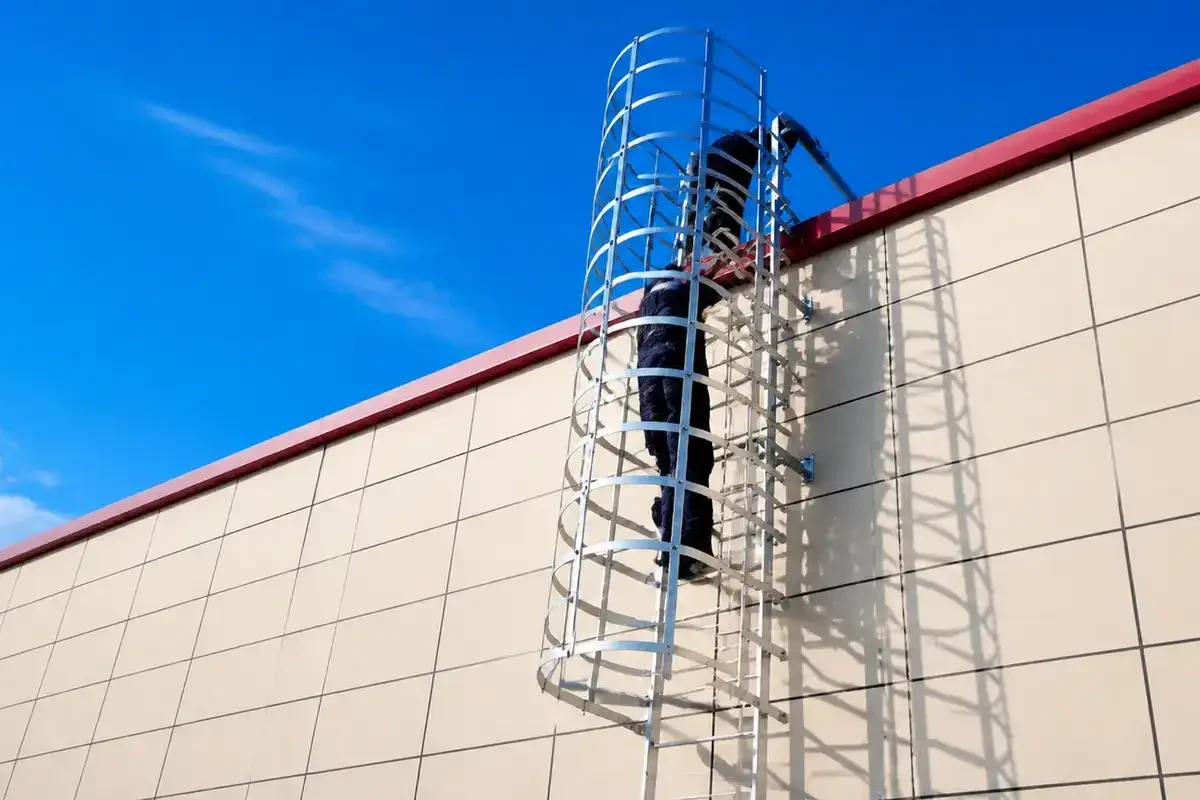
The choice between a fixed ladder (no cage) and a caged ladder (with safety cage) is primarily driven by safety regulations, but cost, user experience, and wind load also factor into the decision. This comparison helps you determine which type is appropriate for your project.
Quick Comparison
| Feature | Fixed Ladder (Uncaged) | Caged Ladder |
|---|---|---|
| Fall protection | None (passive) | Safety cage (passive fall protection) |
| Cost (HDG, 6m) | ~$138 ($23/m) | ~$180 ($30/m) |
| Wind load | Lower (Cf ~1.2-1.6) | Higher (Cf ~1.4-1.8) — +40-60% |
| Weight | ~45 kg (6m) | ~65 kg (6m) |
| Installation complexity | Simpler | More complex (cage assembly) |
| Regulatory threshold (OSHA) | Permitted up to 24 ft (7.3m) | Required for >24 ft (7.3m) |
| Regulatory threshold (EN) | Risk assessment required | One fall protection option |
| Regulatory threshold (AS) | Permitted up to 6m | Required for >6m |
| User comfort | Less confined; easier tool carry | More confined; harder with tools |
| Rescue difficulty | Easier (unobstructed access) | Harder (cage obstructs rescue) |
When to Choose a Fixed Ladder (Uncaged)
Choose an uncaged fixed ladder when:
-
Height is below the regulatory threshold. Under OSHA, ladders up to 24 ft (7.3m) do not require a cage. Under AS 1657, ladders up to 6m are permitted without a cage. Always verify your local standard.
-
Budget is constrained. An uncaged ladder costs approximately 25-35% less than the equivalent caged ladder. For a small project with multiple short ladders, this difference is meaningful.
-
Installation space is tight. An uncaged ladder has a smaller visual and physical footprint. It may be the only option where wall clearance is limited.
-
The ladder is for very infrequent access. If the ladder is accessed monthly or less (e.g., an HVAC maintenance point), the safety benefit of a cage is lower relative to its cost.
-
Users do not carry tools or equipment. A cage restricts movement — carrying tools while climbing inside a cage is difficult and can be unsafe.
Product: Fixed Steel Ladders →
When to Choose a Caged Ladder
Choose a caged ladder when:
-
Regulations require it. OSHA requires a cage (or ladder safety system) for ladders >24 ft (7.3m). AS 1657 requires it >6m. BS 4211 defines a cat ladder as having an integral cage. Follow your local standard.
-
Fall protection is a priority. Even when not legally required, a cage provides passive fall protection that requires no user action, training, or equipment. It is the most foolproof fall protection for occasional-use ladders.
-
Multiple users with varying skill levels will use the ladder. Contractors, maintenance staff from different companies, and occasional visitors may not have personal fall arrest equipment or training. A cage protects all users equally.
-
The ladder is in a visible location. Caged ladders appear more “complete” and professional to safety auditors, insurance inspectors, and visitors. An uncaged ladder may draw unnecessary scrutiny even when it complies.
Product: Caged Ladders →
Cost Comparison
| Ladder Configuration | 4m | 6m | 10m |
|---|---|---|---|
| HDG Fixed (uncaged) | $92 | $138 | $230 |
| HDG Caged | $120 | $180 | $300 |
| SS304 Fixed | $246 | $369 | $615 |
| SS304 Caged | $308 | $462 | $770 |
| SS316 Caged | $460 | $690 | $1,150 |
Prices are FOB Shijiazhuang, per ladder. Cage premium is approximately 25-35% across all materials and heights.
FAQ: Fixed vs Caged Ladder
Q: Can I add a cage to my existing uncaged ladder later?
Yes, if the ladder structure supports the additional wind load of the cage. Dengtai offers retrofit cage kits. The ladder must be inspected for structural adequacy before retrofit. See our Retrofit Guide.
Q: Is a caged ladder the same as a cat ladder?
Not exactly. “Cat ladder” is the UK/Commonwealth term for a caged ladder per BS 4211. The dimensions differ slightly — cat ladders are typically 500mm wide vs 600mm for standard caged ladders. See What Is a Cat Ladder.
Q: Which provides better fall protection — a cage or a ladder safety system?
A ladder safety system (rigid rail or flexible cable with harness attachment) provides superior fall protection because it actively arrests a fall. A cage provides passive containment. OSHA will require ladder safety systems (instead of cages) for new installations after 2036. See Are Cage Ladders Being Phased Out?.
Q: Does a cage make the ladder harder to climb?
Yes, slightly. The cage limits elbow room and makes carrying tools more difficult. However, for occasional access ladders, this is generally an acceptable trade-off for the fall protection the cage provides.
Q: Does adding a cage affect the ladder’s wind rating?
Yes. A cage increases the projected wind area by 40-60%, which increases the force on brackets and anchors. Always verify bracket capacity when adding a cage to an existing ladder or specifying a caged ladder for a high-wind location. Use our Load Calculator to verify.
Frequently Asked Questions
What is the minimum order quantity for steel ladders?
Standard models: 1 unit. Custom-engineered ladders: 5 units minimum. This is one of the lowest MOQs in the Chinese steel ladder manufacturing industry. Most competitors require 10-20 units.
What payment terms does Dengtai accept?
Standard terms: T/T 30% deposit with 70% balance before shipment. For orders exceeding $10,000, L/C at sight is available. We do not accept D/A or open account terms for first-time buyers.
How long does delivery take?
Standard models ship within 15-20 working days of order confirmation. Custom or bulk orders require 30-45 working days. Ocean freight transit adds 15-35 days depending on destination.
What compliance documentation is provided?
Every order includes: Certificate of Origin (CCPIT-issued), Commercial Invoice, Packing List, Bill of Lading, material certificates (EN 10204 Type 3.1), weld inspection reports (ISO 5817), coating thickness reports, dimensional conformance report, and Declaration of Conformity. Additional documentation (Form A/E, fumigation cert, CE/UKCA package) available on request.
Can I get a sample before placing a bulk order?
Yes. Standard model samples can be shipped for evaluation. Freight cost is borne by the buyer (FedEx/DHL). The sample cost is refunded against your first production order.
What is the warranty on Dengtai ladders?
5-year manufacturing defect warranty. Corrosion warranty by material: HDG 2 years, SS304 5 years, SS316 10 years. After-sales: 48-hour response to any issue. If a dimensional error is our fault, we bear the full replacement cost including freight.
How do I start the ordering process?
Send your specification to sales@dtsteelladder.com including: ladder type, height, material, quantity, destination port, and applicable standard. Receive a detailed quotation within 24 hours.
Real-World Project Examples
The following Dengtai case studies demonstrate how proper specification and material selection deliver successful outcomes:
Thailand Petrochemical (2022) — Fixed ladders (no cage) used for short inter-platform runs under 3m. Caged ladders specified for runs exceeding 3m, all per EN ISO 14122-4 requirements. HDG selected for inland non-coastal environment as the cost-effective choice.
Singapore Marina Bay (2023) — SS304 caged ladders selected over HDG for Singapore’s humid marine environment and visible architectural application. The initial cost premium of SS304 ($77/m vs $30/m for HDG) was justified by the 30+ year design life and aesthetic requirements.
Philippines Water Treatment (2023) — SS316 deep well ladders chosen over SS304 and HDG. The HS-rich confined well environment would degrade HDG within 2-3 years and pit SS304 within 10-15. SS316 with acid passivation delivers 40+ year service life in this environment.
These projects are documented in full in our Case Studies section. Each includes project background, technical challenges, solution details, and quantified results.
Dengtai Product Specifications
All Dengtai steel ladders are manufactured to consistent quality standards with the following baseline specifications:
Standard Dimensions:
- Rung spacing: 300mm center-to-center (meets OSHA max 305mm, EN max 300mm, AS max 300mm)
- Rung type: Round bar, 20mm diameter, anti-slip serrated surface
- Stile (side rail) section: Channel or flat bar depending on model and load rating
- Top extension: 1,100mm above landing surface per OSHA 1910.23(d)(4)(iv)
- Bottom clearance: 150-250mm from finished grade
Material Standards:
- Q235B: GB/T 700 (equivalent to EN 1.0038, ASTM A283 Grade C)
- Q345B: GB/T 1591 (equivalent to EN 1.0044, ASTM A572 Grade 50)
- SS304: GB/T 20878 06Cr19Ni10 (equivalent to EN 1.4301, ASTM A240 Type 304)
- SS316: GB/T 20878 06Cr17Ni12Mo2 (equivalent to EN 1.4401, ASTM A240 Type 316)
Surface Treatment Standards:
- Hot-Dip Galvanized: ISO 1461, Fe/Zn115 minimum (coating thickness 80um average)
- Heavy-Duty HDG: ISO 1461, Fe/Zn135 minimum (coating thickness 100um average)
- Stainless Passivation: ASTM A380, nitric acid method
- SS316 Pickling + Passivation: ASTM A380, full chemical treatment
Welding Standards:
- Weld quality: ISO 5817, Level C (general structures)
- Welder qualification: ISO 9606-1
- WPS: Documented per project, qualified per ISO 15614-1
Quality Control Process in Detail
Dengtai applies a five-stage quality control process to every production batch. This systematic approach catches issues when correction costs are lowest.
Stage 1: Incoming Material Inspection
Every batch of incoming steel (plate, bar, channel) is verified against:
- Mill test certificate (chemical composition, mechanical properties)
- Dimensional verification (thickness, width, straightness)
- Visual inspection for surface defects (pitting, lamination, scale)
- Heat number recording for traceability to individual ladder components
Stage 2: Welding Inspection
During and after welding:
- In-process: Welder qualification verification, WPS compliance check, interpass temperature monitoring (stainless steel)
- Post-weld: 100% visual inspection per ISO 17637, weld profile measurement (throat thickness, leg length), spatter check (stainless must be spatter-free)
- NDT sampling: Dye penetrant (PT) on 10% of stainless welds, magnetic particle (MT) on 5% of carbon steel structural welds
- Rejection criteria: Cracks, lack of fusion, incomplete penetration, undercut >0.5mm, porosity cluster >3mm
Stage 3: Surface Treatment Inspection
After galvanizing or passivation:
- HDG: Coating thickness measured at minimum 5 points per ladder section (ISO 2808 magnetic method), uniformity check (no bare spots, no lumps, no ash), adhesion test (visual — no flaking or delamination)
- Stainless passivation: Verification of treatment (copper sulfate test per ASTM A380), surface roughness measurement (target Ra 0.4-0.8um for #240 brushed)
- Acceptance: All measurements recorded against the specification; non-conforming items are re-treated
Stage 4: Pre-Assembly Fit Check
Before packaging:
- Brackets are trial-fitted to stiles to verify bolt hole alignment
- Multi-section ladders: section flanges are aligned and trial-bolted
- Platforms are attached to verify interface fit
- Any interference, misalignment, or fit issue is corrected before proceeding
- Photographs taken of the pre-assembly setup
Stage 5: Final QC and Packaging
Before container loading:
- Dimensional conformance: Overall length, width, rung spacing, cage diameter verified on a sample basis
- Accessories check: All ordered brackets, hardware, platforms, and spare parts are verified present
- Packaging: VCI wrapping per MIL-B-22020, vacuum seal integrity, ISPM 15 stamp verification, crate label accuracy
- Documentation: QC records compiled into the shipment documentation package
- Pre-loading photographs: Every ladder and component photographed in its packaged state
Comparing Dengtai to Industry Alternatives
Dengtai vs. Domestic Distributors (US/EU/AU Markets)
| Factor | Dengtai (Factory-Direct) | Domestic Distributor |
|---|---|---|
| Price | Factory price + freight + duty | 2-4x factory price (includes warehousing, local delivery, compliance admin) |
| Lead time | 8-12 weeks total | 1-2 weeks (from local stock) |
| MOQ | 1 unit (standard models) | 1 unit |
| Customization | Factory-direct engineering | Limited to stocked configurations |
| Documentation | Direct from manufacturer | Distributor back-to-back |
| Best for | Planned procurement, cost-sensitive, custom specs | Emergency replacement, single unit need, local compliance simplicity |
Dengtai vs. Other Chinese Manufacturers
| Factor | Dengtai | Typical Chinese Supplier |
|---|---|---|
| Factory size | 3,000m2 | 500-2,000m2 |
| Export experience | 20+ years, 50+ countries | 3-10 years, 5-15 countries |
| ISO 9001 | Current, verifiable | May be expired or non-genuine |
| Compliance documentation | Full package with every order | May need to be requested/negotiated |
| QC process | Documented 5-stage | May be informal or undocumented |
| Custom engineering | In-house, 3 engineers | May subcontract to third-party workshop |
| After-sales | 48h response, warranty | May be difficult to reach post-delivery |
| English communication | Dedicated sales + engineering | May require translator |
How to Get the Best Price from Dengtai
-
Provide complete specifications upfront — Each clarification back-and-forth adds time. A complete initial inquiry (ladder type, height, material, quantity, destination, standard) produces the fastest, most accurate quotation.
-
Order in container-friendly quantities — Shipping costs per unit drop significantly at full container loads. For standard 6m caged ladders, a 40ft container holds 55-70 units. Freight per unit in a full container is $40-70; LCL (less than container load) is $150-300+.
-
Combine multiple ladder types in one order — A mixed order of fixed ladders, caged ladders, and platforms optimized for container utilization saves freight compared to separate shipments.
-
Consider annual procurement — If you have recurring needs, discuss an annual supply agreement. Committed annual volumes enable: reserved production capacity, lower per-unit pricing, consistent lead times, and priority scheduling.
-
Standardize where possible — Every custom dimension increases cost and lead time. Before spec’ing a custom height, check whether a standard height can meet the requirement. Standard ladders are pre-engineered, cost less, and ship faster.
-
Pay attention to the shipping term — FOB gives you control of freight costs but requires freight forwarder management. CIF provides a single delivered-to-port price but the seller’s forwarder may not be the cheapest. Compare both and choose the best for your logistics situation.
Contact and Ordering
Ready to source steel ladders? Send your specification for a quotation within 24 hours.
What to include in your inquiry:
- Ladder type (fixed, caged, cat, monkey, roof access)
- Material preference (HDG, SS304, SS316) or request a recommendation
- Height (climbing height in meters — we add the top extension)
- Quantity (per type)
- Destination port and country
- Applicable standard (or project country — we identify the standard)
- Any special requirements (ladder safety system, custom color, seismic restraint, classification society)
Email: sales@dtsteelladder.com
WhatsApp: +86 155 1187 9488
Related Resources
- When Is a Cage Required on a Ladder? →
- Ladder Safety Cage Guide →
- Steel vs Aluminum vs FRP →
- Galvanized vs Stainless →
- Fixed Ladder Product Page →
- Caged Ladder Product Page →
Need help deciding? Send your project details for a free specification recommendation.
Email: sales@dtsteelladder.com
WhatsApp: +86 155 1187 9488
Request a Quote → | All Comparisons →
****:vs。:(OSHA 24ft/7.3m、EN 3m、AS 4m、BS 2.5m)。:6m HDG$138 vs $180(25-35%)。:40-60%。5(////)。4(///)。4m/6m/10m。FAQ:(/)、cat ladder vs caged ladder()、vs(OSHA 2036)、。Jouth Zhao。
</script>
Specification Comparison
Compare key specifications at a glance.
| Feature | Fixed Ladder | Caged Ladder | Cat Ladder | Ship Ladder |
|---|---|---|---|---|
| Angle | 90° | 90° | 75° | 60-70° |
| Max Height | 30 m | 40 m | 12 m | 8 m |
| Cage | > threshold | Full height | N/A | N/A |
| Loading | 150 kg | 150 kg | 150 kg | 200 kg |
Not sure which solution fits your project?
Describe your facility and requirements — our engineers will match you to the right industry solution.
Talk to an Engineer →